You can know your strategy, calculate risk and recognise a valid setup. Yet once price starts moving, the decision you make may drift away from the one you prepared: you enter late because you fear missing the move, close early to protect a gain or widen the stop because accepting the loss feels uncomfortable.
Emotion provides context. Behaviour leaves evidence.
What is trading psychology?
Trading psychology examines the distance between plan and execution. It includes emotions, thoughts, biases, habits and responses to uncertainty. It is not about trading without feeling, remaining calm at all times or repeating positive phrases in front of a screen. It is about recognising when an internal state changes an observable decision.
A scientific review of emotion and decision-making shows that affective states can influence attention, risk perception and choice. Their influence is not always harmful, nor does it work identically across people and situations. A serious guide should therefore avoid claiming that psychology explains a fixed percentage of performance or that every loss begins with an emotion.
Trading psychology is the study of how emotional and cognitive processes influence a trader’s decisions before, during and after a trade. Its practical purpose is not to diagnose the person. It is to understand behaviours that may affect trade selection, risk, management and review.
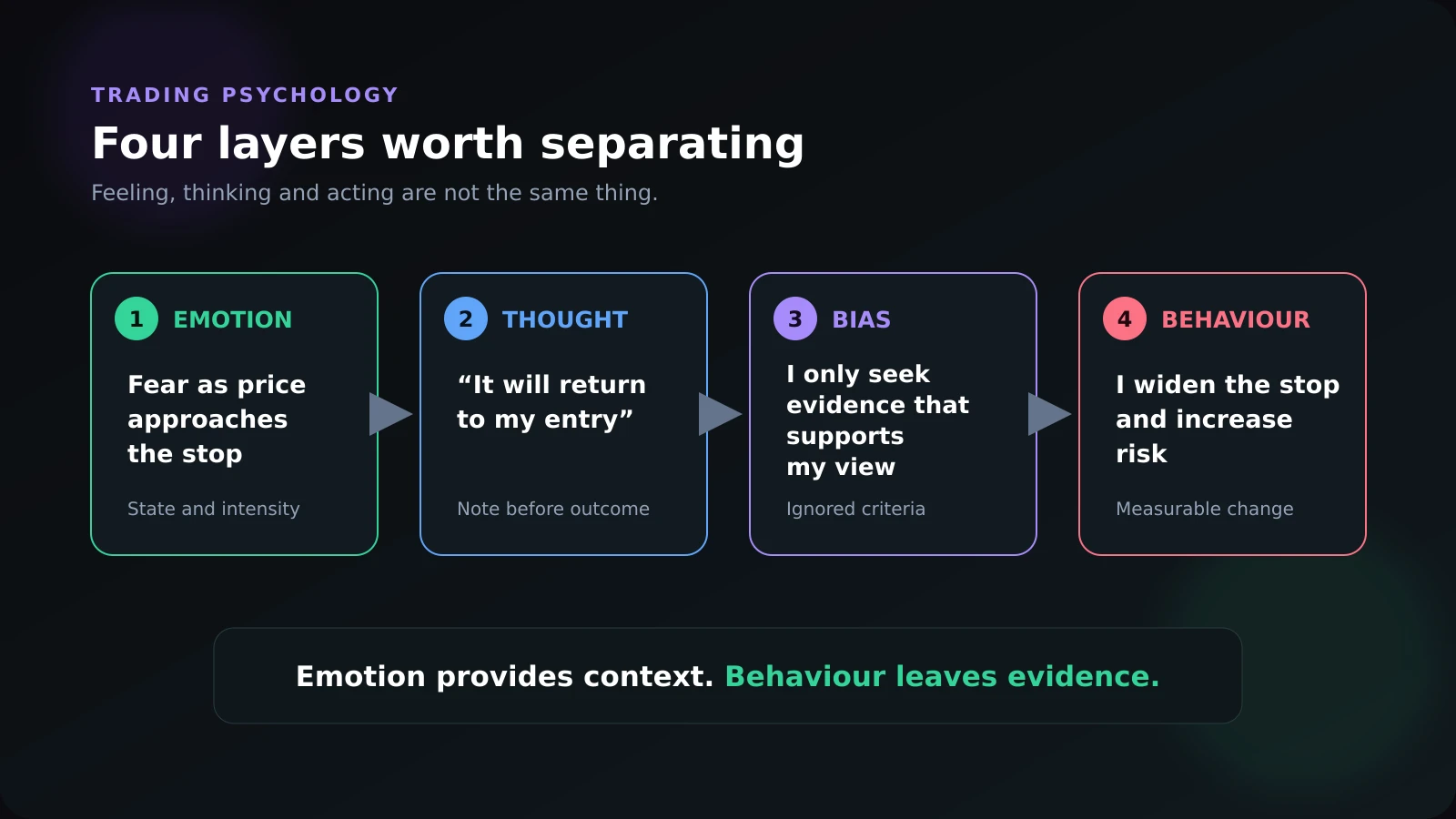
Four layers are often mixed together:
An emotion is not the same as a poor trade. You can feel fear and follow the plan. You can also feel calm while taking a level of risk you have never validated. The useful question is not whether you resemble an unshakeable trader. It is whether your decisions retain the logic you defined before the outcome could influence you.
Emotion
Fear as price approaches the stop — Intensity, moment and context
Thought
‘It will surely return to my entry’ — A short note captured before the outcome
Bias
Looking only for arguments that support the position — Sources consulted and criteria ignored
Behaviour
Widening the stop or adding size — Risk change, time and stated reason
Emotions are not the trader’s enemy
The advice to ‘remove emotion’ starts from an overly simple model. Emotion and reason do not operate as separate switches. Scientific reviews by Jennifer Lerner and colleagues describe emotions as powerful and sometimes predictable influences on judgement and choice; they can also provide relevant information. Affective neuroscience proposes a modulatory relationship: emotional state can change the value assigned to an option, while the act of choosing can itself generate emotion.
The problem begins when emotion changes a variable that should have remained protected: position size, invalidation, entry criteria, exit or daily limit. At that point, it leaves a trace that can be compared.
Urgency may warn you that you are about to chase price. Frustration may indicate that the previous loss still directs your attention. Euphoria may accompany a winning streak and reduce perceived risk. None of these states commands an action by itself. A rule, pause or check can exist between feeling and execution.
Improving trading psychology does not mean feeling less. It means giving intense emotion less power to rewrite the plan.
Seven common psychological patterns in trading
1. Fear of losing
Fear can lead a trader to avoid a valid entry, reduce size without a rule or close before invalidation occurs. It can also be a reasonable signal: perhaps the planned risk is too high for your real tolerance, or the setup is not clearly defined.
Before labelling the behaviour as a lack of confidence, check whether you understand the potential loss, whether the stop has a rationale and whether you would accept that loss before opening the trade.
2. FOMO trading
Fear of missing out often emerges after a move has started and the opportunity appears to be escaping. Its signature is not urgency itself but the behaviour that follows: an entry farther from the planned level, a weaker risk-reward ratio, incomplete validation or position size decided in haste.
A missed opportunity is not an accounting loss. When the mind treats both as equivalent, entering late can feel like repairing something that has not actually happened.
3. Loss aversion
Loss aversion describes greater sensitivity to losing than to a comparable gain, although the magnitude depends on context and there is no universal ratio that applies to every trader. It may appear as delaying the exit from an invalidated trade, moving the stop, adding risk to improve the average entry or securing a gain too early.
Terrance Odean found, after analysing records from 10,000 accounts, a stronger preference for realising gains than losses, a behaviour known as the disposition effect.
TRAZZA explores this pattern in the guide to loss aversion in trading.
4. Revenge trading
After a loss, the objective may shift from executing the plan to recovering money or proving the market view was correct. Revenge trading is not defined by trading again quickly. It is defined by a reactive change: fewer criteria, more size, less waiting or more trades than planned.
The guide to behaviour after a loss explains how to compare that sequence without treating every subsequent trade as a false positive.
5. Overconfidence
A winning streak can build confidence, but it may also encourage the trader to attribute too much of the outcome to skill. The behavioural signature appears when size increases without a prior rule, untested setups enter the plan or checks disappear because you feel ‘in tune with the market’.
Barber and Odean analysed more than 35,000 households and connected higher trading activity with models of overconfidence; the group that traded more earned lower risk-adjusted net returns. The study does not establish the same effect for every trader or market, but it offers a useful reminder: more conviction and more activity do not automatically mean better decisions.
6. Confirmation bias
Confirmation bias favours seeking, interpreting or remembering information that supports an existing belief. In an open trade, it may appear as redrawing the analysis, adding indicators until one agrees or dismissing an invalidation signal that previously mattered.
A simple defence is to define before entry what evidence would show that the hypothesis is wrong. If that answer changes after the position is open, record the change and the reason.
7. Recency bias and outcome bias
Recency gives disproportionate weight to the latest trades. Two losses may convince you that the strategy has stopped working; two wins may make you feel that you have mastered it. Outcome bias adds another distortion: judging the decision by the profit or loss that followed.
A win does not prove that the entry was sound, and a loss does not prove the opposite. A winning trade can still be badly executed explains how to separate process from outcome.
What trading psychology looks like in your data
An emotional label says little in isolation. It becomes useful when connected to a decision and a reference. The question is not ‘Do I trade worse when I am afraid?’ but ‘When I record fear at 4/5, do I enter farther from my planned level than in comparable opportunities scored at 1 or 2?’
Do not infer a psychological cause from coincidence. Late entries may cluster in more volatile sessions; size may change because the stop is tighter; trades after a loss may belong to a different setup. The guide to when a trading pattern becomes evidence helps build more honest comparisons.
‘I am going to miss the move’
Chased entry — Planned versus executed entry distance
‘It will surely recover’
Stop moved farther away — Initial risk versus maximum actual risk
‘I am reading the market really well today’
Position size increased — Risk after a winning streak versus baseline
‘I need to recover the loss’
Reactive new entry — Time, setup and risk after a loss
‘This strategy no longer works’
Premature change — Recent sample versus comparable history
‘The market proved me right’
Deviation reinforced by a win — Plan adherence versus outcome
‘I only need one more confirmation’
Prolonged or selective analysis — Prior criteria versus criteria added later
How to record emotion without turning a journal into therapy
A trading journal does not need an autobiography after every trade. Record the minimum needed to reconstruct the decision.
Before trading: note the dominant state, a simple intensity score from 1 to 5, the setup, entry level, invalidation and maximum risk. Your trading plan should define the general rules; the journal preserves how they were applied.
During the trade: capture only meaningful changes. If you move the stop, add size or exit early, note the time and the reason using the words you had then. You do not need to narrate every candle.
After the close: separate outcome, execution and reaction. A note such as ‘frustration 4/5; opened the next trade three minutes later without waiting for confirmation’ can be compared. ‘It was a disaster’ defines no variable.
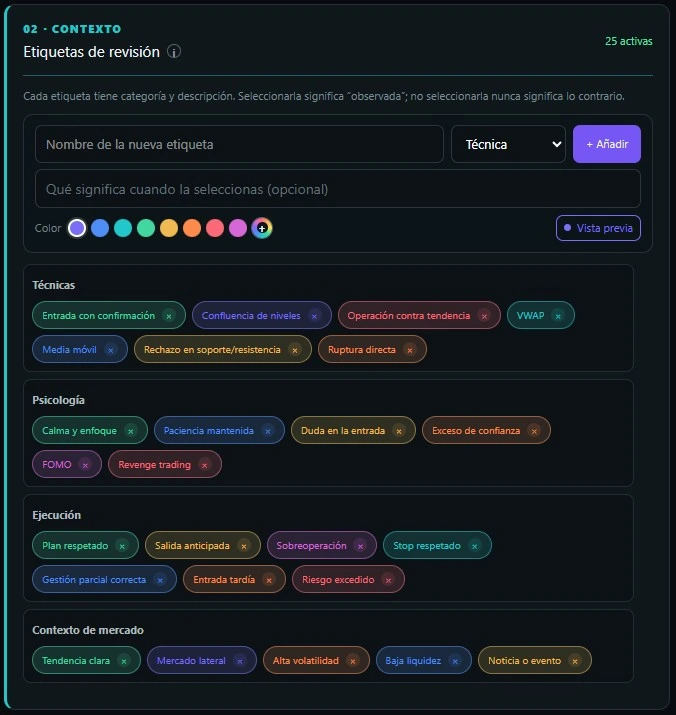
Keep the label set small and define labels through behaviour. ‘Urgency’ might mean entering before the signal; ‘doubt’ might mean repeatedly checking an already validated setup; ‘overconfidence’ might mean skipping checks or exceeding the usual risk. The guide to recording emotions in a trading journal develops this vocabulary.
Recording does not turn an emotion into a cause or guarantee control. It preserves context so that you can form and later test a hypothesis.
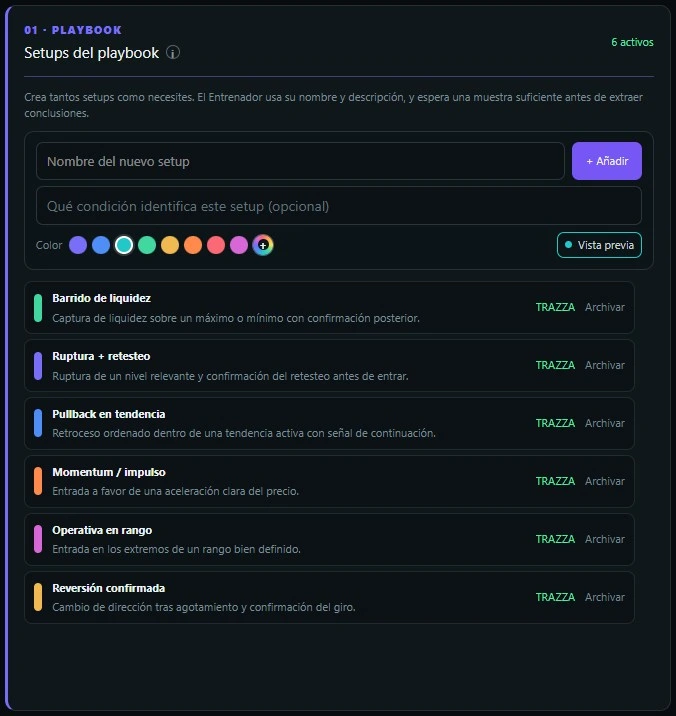
A protocol for improving trading psychology
Before the session: reduce improvised decisions
Define the permitted setups, risk range, loss limit, pause conditions and invalidation for each idea. The more important the decision, the less it should depend on how you feel once price is moving.
Use a short check:
- Does this entry belong to a defined setup?
- Do I know what invalidates it?
- Does the size respect my maximum risk?
- Would I accept this loss without changing the plan?
- Is there any condition that argues against trading today?
During the trade: create distance between impulse and action
Do not try to debate every emotion for five minutes. Protect the critical variables. You might require a second check before moving a stop, prohibit unplanned increases in risk or add a pause after a loss. Trading rules for disciplined execution work best when they specify a trigger, response and record.
The pause does not need to be identical for everyone. It should be long enough to restore the process and concrete enough to follow.
Afterwards: review without negotiating with the outcome
First reconstruct the decision using only the information available at entry. Evaluate setup, risk, entry, management and exit. Add P&L afterwards. This order reduces the risk of rewarding an improvised decision because it ended well or punishing sound execution because it lost.
Every week: choose one behaviour
A weekly trading review can follow six steps:
‘Control FOMO better’ is an intention. ‘For the next ten opportunities, I will not enter more than 0.25R beyond my planned level’ is a testable rule.
- Check that no trades or essential data are missing.
- Group comparable opportunities by setup and context.
- Compare the behaviour with a baseline.
- Inspect two or three cases, not just the worst one.
- Define one barrier for the following week.
- Decide how adherence will be measured.
When the problem is not psychology
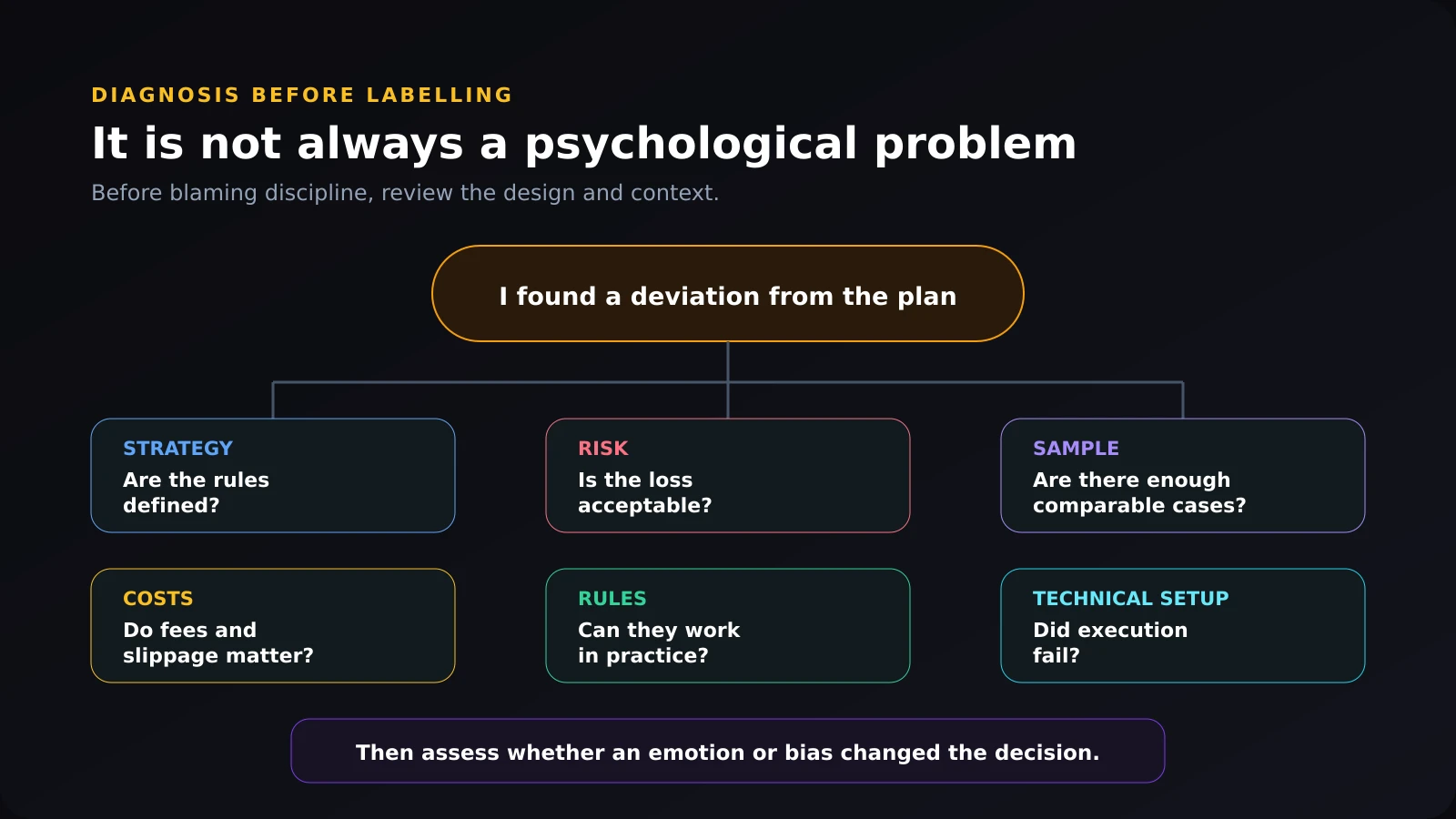
A psychological label can hide a design problem. Before concluding that you lack discipline, test these alternatives:
Trader psychology should not become a total explanation. A good review considers strategy, risk, execution, context and behaviour before assigning a cause.
- The strategy is undefined. You cannot measure adherence if entry, invalidation and exit change in every trade.
- Risk is too high. If a normal loss is unacceptable, the emotional response may be signalling exposure that does not fit your circumstances.
- The sample is insufficient. Three losses do not show that a strategy has stopped working, just as three wins do not validate a setup.
- Costs alter the result. Fees, funding and slippage can turn reasonable execution into a different net outcome.
- The rules are impractical. A plan that demands constant attention or ambiguous decisions creates violations despite good intentions.
- The technical environment fails. Latency, rejected orders or incomplete data should not be classified as emotional mistakes.
- Distress extends beyond trading. A journal is an educational observation tool, not a replacement for support from a qualified mental-health professional.
How TRAZZA can help
Emotions do not appear in broker history by themselves. The decisions associated with them can leave a trace: entry time, distance from plan, size, actual risk, stop changes, post-loss sequence and adherence.
TRAZZA connects the objective trade record with context, labels and review. It does not decide which emotion was responsible or promise to correct behaviour. It helps you compare plan with execution, gather similar cases and turn a finding into a measurable mission.
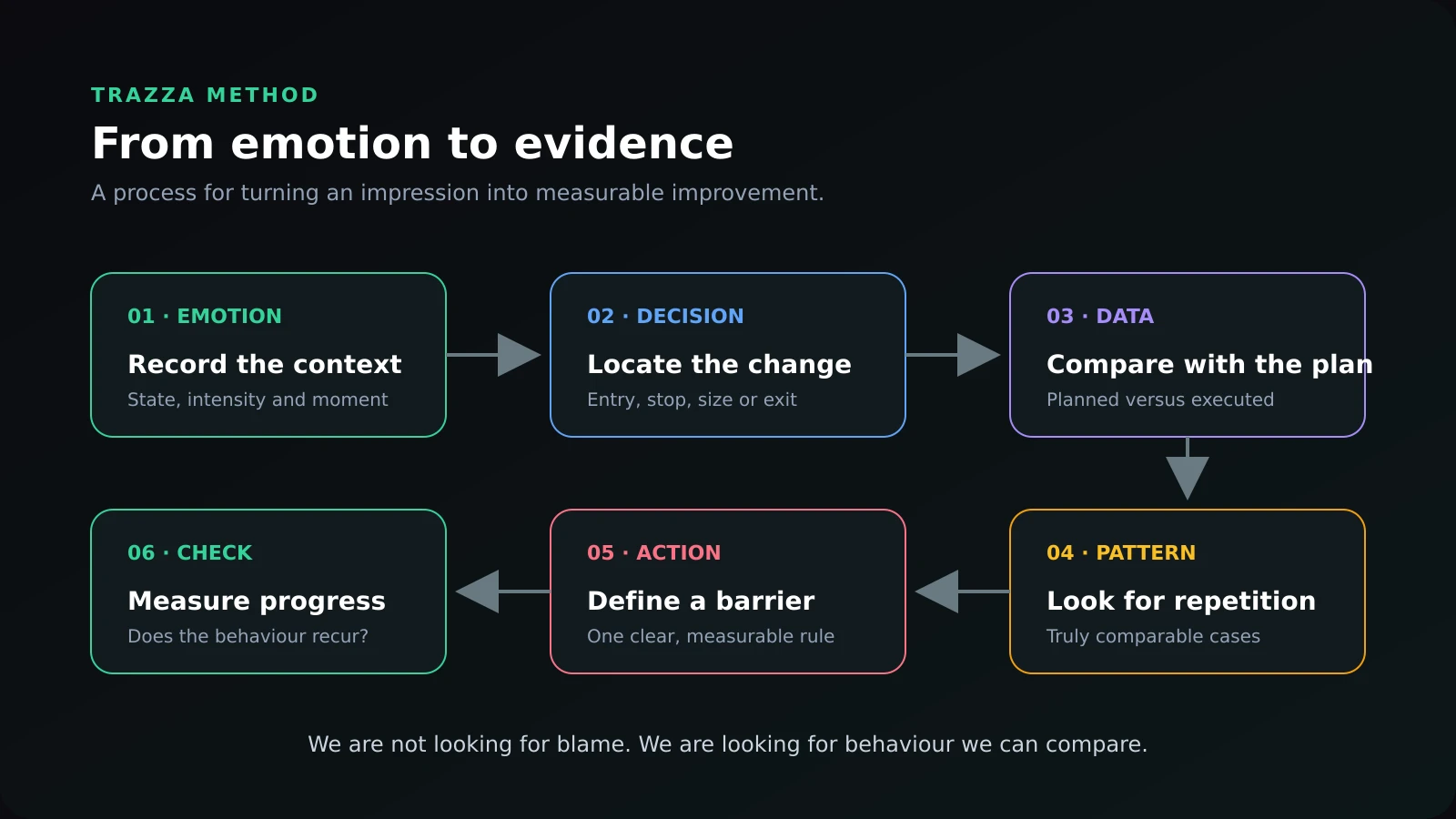
The sequence is simple:
emotion → decision → data → pattern → action → verification.
Explore how TRAZZA works.
You can also learn about the TRAZZA Method.
If you want to try this system before public release, request access to the private beta.
We do not measure success by the trades you win, but by the trader you are becoming. Trading psychology stops being an abstract explanation when you can observe whether your decisions are evolving.
Frequently asked questions
What is trading psychology?+
It is the study of how emotions, thoughts, biases and habits influence a trader’s decisions. In practice, it examines whether these factors change entry, risk, management, exit or adherence to the plan.
How can I control emotions in trading?+
You do not need to eliminate emotion. Define rules before trading, record states and behaviours, protect risk variables and review whether certain contexts coincide with repeated deviations. The aim is to reduce their influence on critical decisions.
Is psychology more important than strategy?+
There is no universal percentage. An unsound strategy does not improve merely because it is followed with discipline, while a strategy with an edge can deteriorate through persistent deviations. Strategy, risk, execution and psychology are different parts of one process.
How do I know if I am emotional trading?+
Look for changes from your baseline: late entries, increased risk, widened stops, early exits, more trades after a loss or rules changed during a streak. A single incident does not establish a pattern.
Can a journal improve trader psychology?+
It can help preserve context, compare decisions and identify repeated behaviours. It cannot guarantee better results or replace mental-health care. Its value depends on recording close to the decision and reviewing comparable samples.
How long does it take to improve trading psychology?+
There is no timeline that applies to everyone. It depends on the behaviour, its frequency, the environment and the quality of the record. Measure progress through observable decisions—risk respected, pauses followed or entries kept within plan—rather than expecting complete transformation within a fixed number of days. Educational content. This is not financial advice, an investment recommendation or a signal to buy or sell.