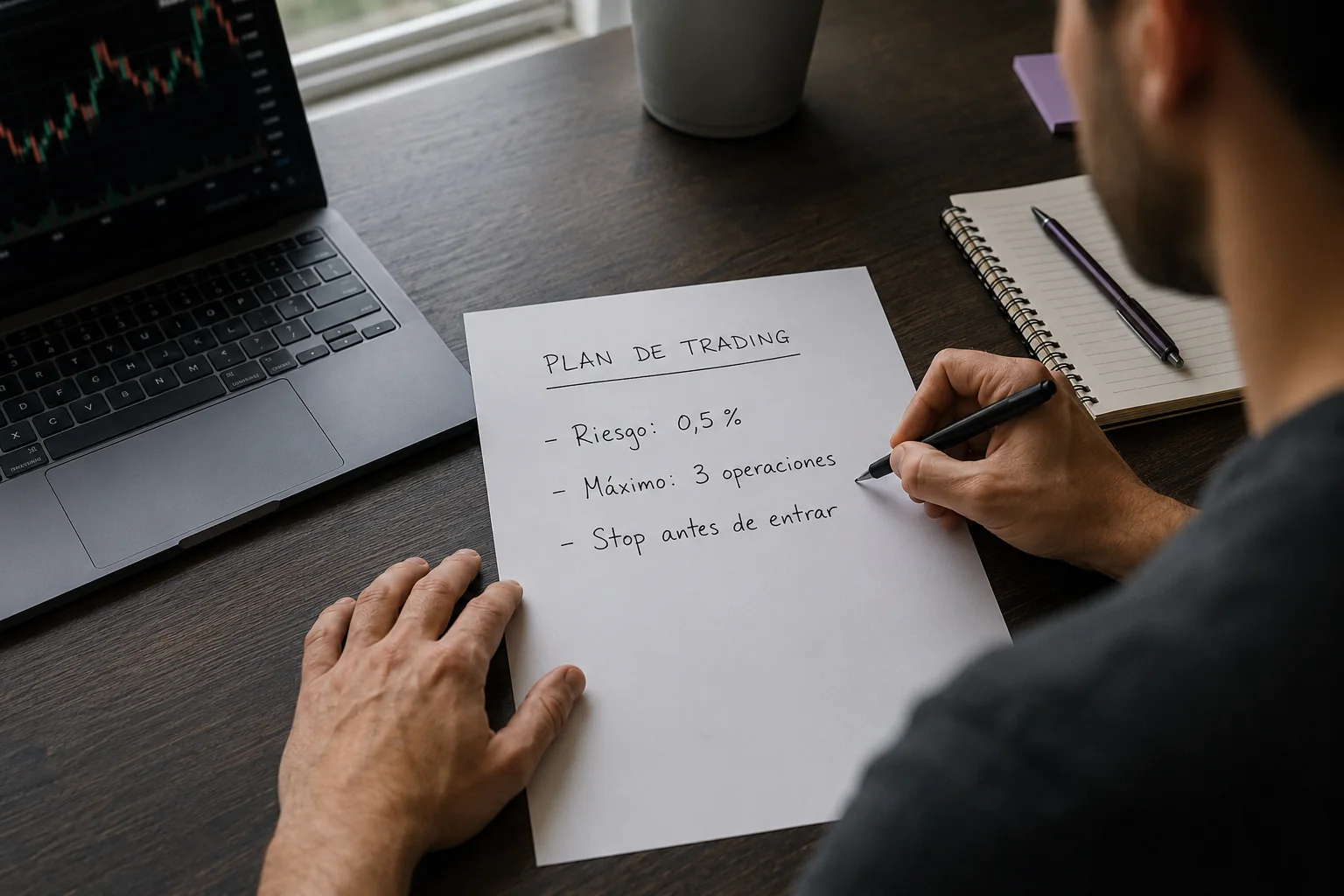
A trading plan does not predict what the market will do. It decides in advance what you will do. It defines where you may trade, how much risk you will accept, which conditions justify an entry and when you must stop. Without that framework, every candle can become an excuse and every outcome a new improvised rule.
The market will remain uncertain. Your behaviour does not have to be.
What a trading plan is and why you need one
A trading plan is an operating document that brings together your markets, sessions, setups, risk, entries, management, exits and review process. It is not a motivational statement or a secret strategy. It is the standard used to decide whether a trade is allowed before its outcome is known.
Its value becomes clearer under pressure. After a loss, during a fast breakout or when price moves without you, the mind can produce reasons to act. A plan reduces that room for internal negotiation. It does not remove emotion, but it prevents each emotion from gaining authority to rewrite the method.
A vague intention is not a trading rule
Statements such as “trade carefully”, “avoid overtrading” and “cut losses” cannot be audited. A rule needs a boundary, condition or observable action.
Replace “trade carefully” with “risk no more than 0.75% per trade”. Replace “do not overtrade” with “take no more than three trades per day”. Replace “stop when upset” with “end the session after two consecutive losses”. Precision does not guarantee discipline, but it makes deviation visible.
- Intention: find good opportunities. Rule: trade only setups A and B.
- Intention: always use a stop. Rule: define invalidation and stop before confirming entry.
- Intention: avoid excessive risk. Rule: cap each trade at 0.75% and combined exposure at 1.5%.
- Intention: do not chase price. Rule: cancel if price moves more than 0.25R from the planned level.

Define markets, assets, sessions and time frames
The first boundary is deciding where you will not trade. Too many markets create noise and make comparable samples difficult. Start with a small group of assets, a specific session and defined context and execution time frames.
Write down permitted instruments, trading windows, excluded days and both context and execution time frames. Boredom at midnight should not silently create a new strategy on an unfamiliar asset. Decide in advance how you will handle news, market openings and exceptional volatility.
Describe the setups you are allowed to trade
A setup is a repeatable configuration, not a feeling that price looks attractive. Define context, level, trigger, invalidation and exclusion conditions. Keep screenshots of valid and invalid examples.
One or two clear setups are more useful than seven loosely applied ideas. An exception does not become a new setup merely because it won.
- Context: trend, range, structure or relevant zone.
- Trigger: the observable event that permits execution.
- Invalidation: the condition showing that the hypothesis is no longer valid.
- Filters: volatility, time, liquidity, news and distance to target.
- Exclusions: similar situations that do not qualify.
How much to risk per trade
Risk per trade is the capital you are prepared to lose if the stop is hit. Define it before calculating position size. There is no universal percentage: it depends on capital, strategy, frequency, costs and the drawdown you can tolerate.
If the account is €10,000 and planned risk is 0.75%, the maximum planned loss is €75 before fees and slippage. Position size adapts to stop distance; the stop should not be tightened simply to obtain a larger position.
Cap combined exposure as well. Three correlated positions at 0.75% may behave like one 2.25% bet.
Set daily and weekly maximum loss
A daily loss limit protects capital and prevents a difficult session from turning into a recovery attempt. It may be expressed as a percentage, amount or R units, and it should include closed losses plus remaining open risk.
Once reached, the session ends. There is no final reduced-size attempt and no switch to another market. A boundary that can be renegotiated under pressure is not a boundary.
A weekly limit interrupts a sequence before frustration accumulates. Reaching it calls for review, not an automatic conclusion that the strategy is broken.
How many trades per day and how to avoid overtrading
The maximum number should fit your strategy and your ability to preserve decision quality. No single number suits everyone, but the limit must be set before the session.
A fourth trade is not justified because the first three lost or because the market appears to offer one last exceptional opportunity. The limit prevents accumulated P&L from changing your frequency.
Record the number of trades, discarded attempts, time between entries and setup quality. Overtrading often appears as progressively weaker validation rather than simply a large count.
Entry, invalidation, stop and target before execution
Before entering, write why you are entering, what invalidates the idea, where that invalidation becomes a stop and under which condition you will exit in profit. If one appears only after execution, the decision was incomplete.
Entry may be an exact level or a zone combined with an observable trigger. The stop must follow the trade thesis, not the amount you would prefer to lose. Targets may be fixed, structural or rule-managed, but they still need a precise definition.
Define the no-entry scenario as well. Cancel when confirmation is missing, risk-reward ratio falls below the minimum or price moves beyond the permitted distance. Missing a trade is not a plan violation; chasing it may be.

Rules while the position is open
Specify partial exits, stop movement, adding size and early closure. “Move to break-even when it feels right” is not a rule. A measurable rule might require price to reach 1R and confirm new structure first.
If partial exits are allowed, define the percentage and level. If widening the stop or adding to a losing position is prohibited, write that prohibition explicitly so pressure cannot reinterpret it.
Include technical incidents such as connection loss, platform errors or unexpected events. An operating protocol prevents a technical problem from becoming an improvised market opinion.
TRAZZA Risk Plan turns boundaries into visible references
A written plan is the start. TRAZZA journaling can preserve maximum risk per trade, daily loss, trade count and permitted markets alongside the rest of your trading history.
The demonstration card uses simulated values: a €10,000 reference account, 0.75% risk per trade, 2% daily loss, three trades and two consecutive losses as a stopping condition. These are examples, not universal recommendations.
During review, the TRAZZA trading journal can connect the declared plan with imported trades, notes and management decisions. TRAZZA does not decide for you; it makes the distance between intention and behaviour easier to see.
Conditions that force you to stop
Add operational and personal stop conditions to the financial limit: two consecutive losses, a serious rule violation, repeated technical errors, fatigue or an inability to explain the next setup.
Keep them simple. When one appears, record the reason and leave the platform for the agreed period. Stopping does not predict the next trade; it acknowledges that the conditions required by your process are absent.
What to do after a loss
A planned loss does not require a new method. Close the record, preserve context and ask whether the next opportunity exists independently of the need to recover.
Use a fifteen-minute pause, wait for a candle close or repeat the checklist from the beginning. After two consecutive losses, the plan may reduce risk or end the session. The response should already exist before frustration appears.
A pause is not punishment. It separates a past result from a future decision.
A profit can also break the plan
Profits made outside the rules are dangerous because they reward deviation. If you double risk, chase entry and win, the balance may teach the wrong lesson.
Record the breach despite the positive outcome. Evaluate process and P&L separately so lucky exceptions do not contaminate the sample.
An intraday trading plan example
Imagine a trader operating BTC and ETH futures during the first part of the European session. Only one pullback-continuation setup is permitted, with a minimum target of 1.8R and no trading around major news.
Base risk is 0.50%, combined exposure is capped at 1%, and the maximum is three trades. A loss triggers a fifteen-minute pause; two consecutive losses or a -1.5% day ends the session. Confirmation, invalidation and stop are defined before entry.
The trader may take 50% off at 1R and manage the remainder by structure. Every Friday, twenty comparable trades are reviewed before proposing a change.
This example is not a universal model to copy. Its purpose is to show how every sentence produces an observable decision and how the rules fit together.
Trading plan template
- Purpose and review period.
- Permitted markets, assets, sessions and time frames.
- Setup context, trigger, invalidation, filters and exclusions.
- Risk per trade and position-size method.
- Combined exposure and correlated assets.
- Daily and weekly maximum loss.
- Maximum trades, minimum pause and stop conditions.
- Entry, stop, target, partial exits and stop movement.
- Technical incident protocol.
- Data, screenshots and notes to record.
- Sample size and criteria required to change a rule.
Review the plan without changing it after every loss
A plan needs stability to create comparable data. Define when execution will be reviewed and what sample is required before changing strategy.
Separate clarification from a new hypothesis and backtest strategic changes with fixed rules. A poorly written rule can be clarified immediately; a strategic change needs evidence, a start date and its own version.
Review adherence, expectancy by setup, drawdown, outcome distribution and market conditions. Discipline cannot make a strategy with no edge profitable, so review both execution and validity.
Use a trading journal to measure adherence
A trading journal the plan to evidence. Record setup validity, planned and actual risk, trade number, management and exit reason. Then measure which rules were followed and where deviations cluster.
TRAZZA Total describes this complete view of trade, context and behaviour. Importing P&L alone is not enough to learn. You need to know what you intended, what you did and what repeats.
Searches for TRAZZA journaling, TRAZZA trading journal or TRAZZA Risk Plan should lead to the same idea: the platform does not replace a plan; it helps make that plan verifiable over time.
Your plan begins before the next trade
Write permitted markets, one setup, maximum risk, daily loss, trade count and exit conditions. That first version already removes decisions currently made under pressure.
Then record and review. If a rule is broken, investigate the context. If it is followed but the strategy fails, test the hypothesis with enough data. If the plan is too complex to use, simplify it.
Every trade leaves a lesson when it can be compared with a prior intention. This is where a trading plan and TRAZZA meet: decide first, verify afterwards and evolve over time.
Review checklist
- ✓Define permitted markets, sessions and setups.
- ✓Set risk per trade and combined exposure.
- ✓Write daily and weekly maximum loss.
- ✓Limit trades and define stop conditions.
- ✓Set entry, invalidation, stop and exit before execution.
- ✓Record every deviation, including profitable ones.
- ✓Review adherence and strategy with comparable samples.
- ✓Version changes instead of improvising them.
Frequently asked questions
How long should a trading plan be?+
Long enough to remove ambiguity and short enough to consult before trading. One or two operating pages can link to setup examples, supporting evidence and technical protocols.
What is the right maximum risk per trade?+
There is no universal percentage. It must fit the strategy, frequency, expected losing sequences, capital, costs and your ability to execute without changing the rules.
How many trades should I take per day?+
As many as the strategy allows without reducing decision quality. Set the limit before the session and do not increase it to recover losses.
Can I change the plan when the market changes?+
Yes, but deliberately, with evidence and a new version. Adapting a rule outside the session is different from improvising it while a position is open.
Does a trading plan guarantee profit?+
No. It reduces improvisation, limits risk and creates comparable decisions. Profitability also requires a genuine edge, controlled costs and consistent execution.