
A trade reaches its closing level, but the trader moves the stop. Another entry improves the average price, followed by a promise to exit at break-even. A planned loss has become exposure that was never calculated. The problem is not always losing. Sometimes it is everything we do to avoid admitting that a trade no longer meets its original thesis.
Am I managing this position according to my plan, or am I changing the plan so I do not have to accept the loss?
What loss aversion means
Loss aversion is the tendency to give greater psychological weight to a loss than to a comparable gain. It forms part of prospect theory, developed by Daniel Kahneman and Amos Tversky. In trading, it appears when avoiding a negative result outweighs the rules of the trading plan.
This does not mean every loss hurts exactly twice as much as an equivalent gain feels good. Estimates vary with context, stakes and method. Evidence supports the effect, but it also requires qualification.
Before entry, the stop is a number. As price approaches it, the stop becomes a real decision. Thoughts such as “price will reverse” or “one more entry will get me out flat” are warning signs when they replace prior criteria.
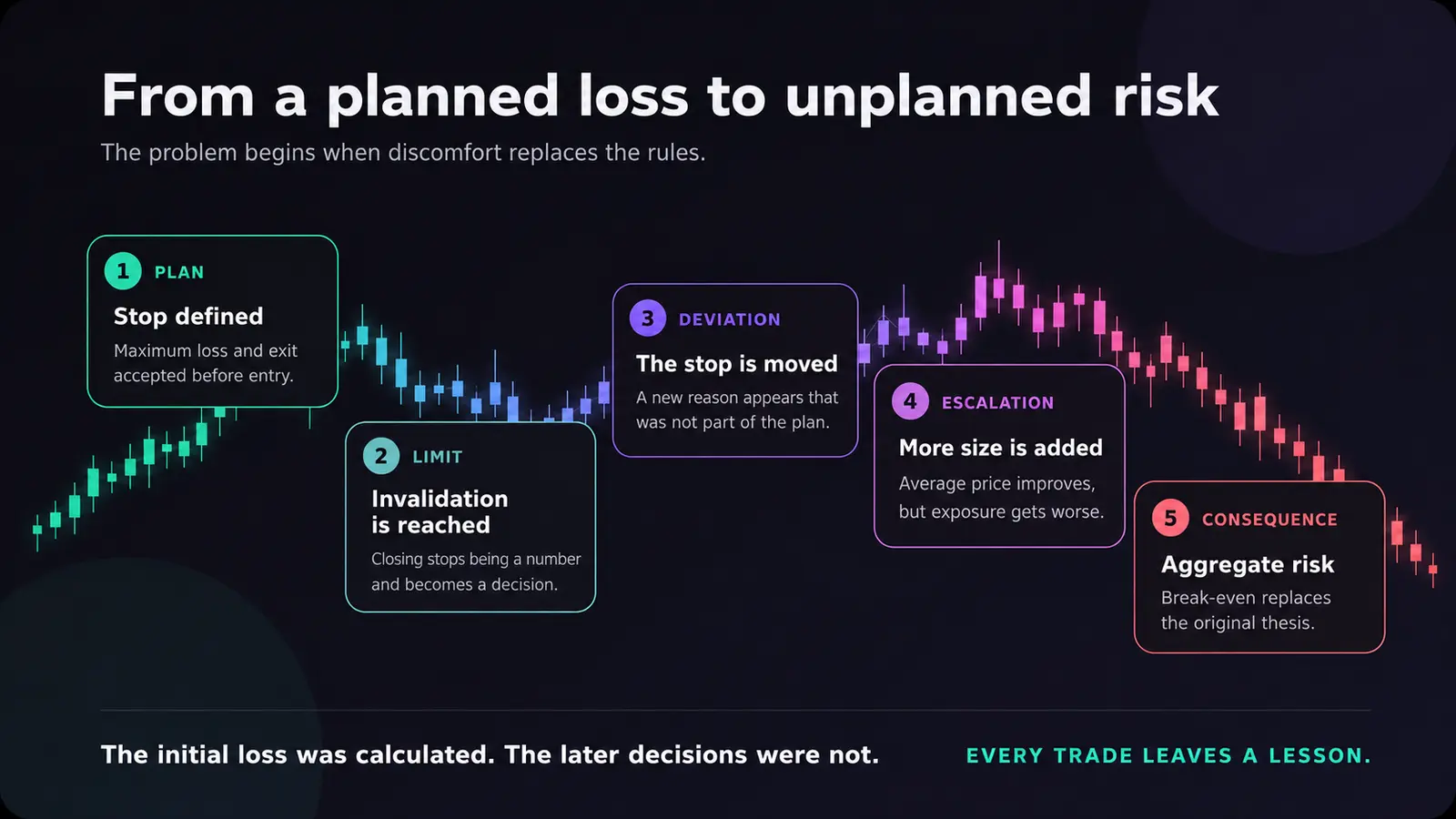
Six observable signs in an open trade
Discomfort alone does not prove loss aversion. The pattern should be investigated by comparing repeated behaviour with the rules that were in force before the position was opened.
1. Moving or removing the stop without a prior rule
Changing a stop can be valid when it reduces risk or follows a predefined condition. The warning sign is moving it farther away to give an invalidated trade “more room”.
2. Adding size without recalculating total risk
An additional entry improves the average price but increases exposure. The central question is how much the whole position can lose now, not how much better the average looks on screen.
3. Turning break-even into the only objective
The entry price is a personal reference point, not an obligation for the market. Returning to break-even does not restore the original thesis.
4. Cutting winners early while widening losers
The urge to secure a gain can coexist with resistance to closing a loss. A high win rate does not necessarily compensate for a few exceptional losses.
5. Holding after the thesis has been invalidated
Price can move against a trade without invalidating it; the difference should be defined in advance. If the reason disappears but the position remains because price “has to come back”, hope has replaced evidence.
6. Abandoning a consistent risk unit
As a loss grows, it is easy to choose whichever figure feels least uncomfortable. A stable measure such as account percentage or multiples of initial risk (R) preserves perspective.
Planned scaling is not averaging down on hope
Adding to a losing position is not automatically a mistake. A planned scale-in defines levels, number and size of entries, common invalidation and maximum total risk in advance. Hope-driven averaging works in reverse: it begins after the loss appears, aims to avoid closing it and ignores a global risk budget.
A useful test is: with no open position, would I take this entry with the same size and stop? If not, the decision may be defending the previous trade.
Loss aversion, fear and revenge trading
They can overlap, but usually describe different moments. Fear of losing may prevent a valid entry or trigger an early exit. Loss aversion changes the management of a losing position that remains open. Revenge trading appears afterwards and pushes the trader to force another trade to recover the result.
The patterns can form a chain: a trader avoids closing, absorbs a larger loss and tries to recover it through another trade. Separating the phases reveals where the process broke down.
The disposition effect: selling winners and holding losers
The disposition effect describes a tendency to realise gains more readily than losses. In a study of 10,000 brokerage accounts, Terrance Odean found a preference for selling winners rather than losers that rebalancing, trading costs and subsequent performance did not explain.
Loss aversion is not the only explanation. Mental accounting, reversal beliefs and pride may also contribute. The practical task is to test the trader’s own history: duration, early exits, losses beyond planned risk and stop changes.
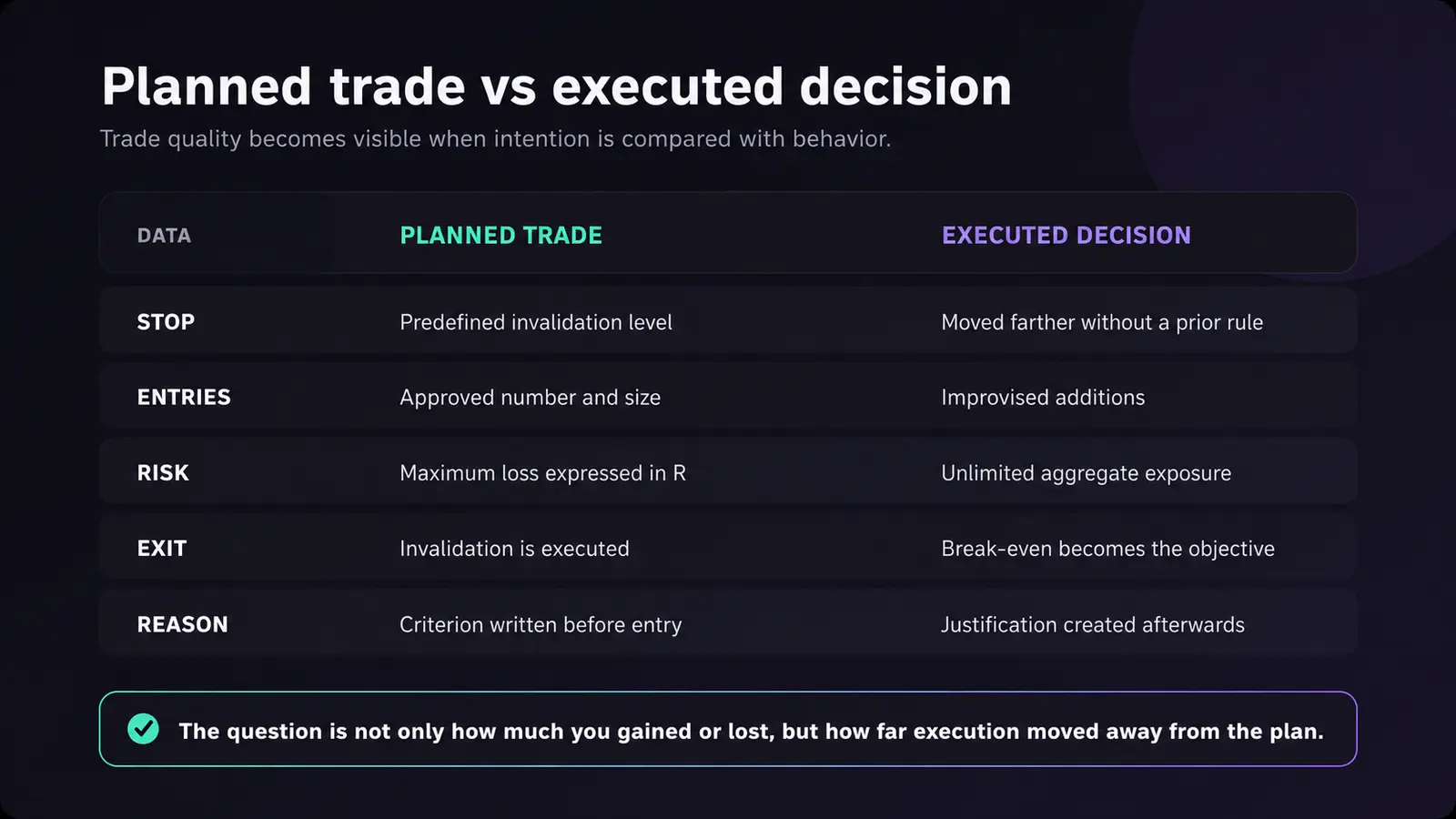
What to record to identify the pattern
Memory reconstructs decisions using later information. A trading journal compares original intention with execution without relying only on the story told after the outcome.
Recording emotions adds context, but it should not turn them into an automatic explanation. Observable behaviour — a moved stop, added size or delayed exit — is what can be compared.
TRAZZA records trades, reviews decisions and finds repeated patterns. It does not predict the market or decide where a stop belongs. It turns “I hold losers too long” into a question that can be tested against history.
- Planned entry, stop, target and thesis.
- Initial risk in currency, account percentage and R.
- Changes during the trade, with time and reason.
- Added entries and total risk after each one.
- Executed exit and its distance from the plan.
- The outcome the original plan would have produced.
A protocol before, during and after a loss
Before entry
Define invalidation, maximum risk and conditions for adding entries or changing stops. Calculate size in advance. The risk-reward ratio cannot guarantee the result, but it makes accepted risk and expected return visible.
During the trade
Do not add size without updating risk. Write down new reasons before acting and separate a rule from a justification created by the loss. If you feel an urge to “fix” the position, a brief pause helps restore the process.
After the close
Evaluate decision and result separately. Compare stops, check the limit and look for repetition across a sample. Then turn the finding into a testable rule.
Accepting a loss does not mean trading without emotion
Acceptance does not mean enjoying a loss or closing without reason. It means recognising that it belonged to an uncertain process and that protecting capital matters more than defending a prediction.
A loser can follow the plan. A winner can hide a poor decision if its stop was removed and the market happened to reverse. Outcome and execution need separate measures.
The TRAZZA Method separates outcome from decision quality.
Its process is to record, contextualise, discover, act and evolve. The goal is not to eliminate emotion, but to stop it changing risk without being recorded and reviewed.
Request access to TRAZZA if you want to analyse your trading with that approach.
Frequently asked questions
How can traders learn to accept losses?+
Define acceptable loss, invalidation and permitted changes before entry. Then evaluate plan compliance separately from outcome. Accepting a loss means executing risk that was approved in advance, not giving up.
Is moving a stop loss always wrong?+
No. It can be valid when it reduces risk or follows a predefined condition. Moving it farther away to prevent an exit, without a prior rule and while increasing maximum loss, is a behaviour worth reviewing.
Is averaging down always a bad strategy?+
Not necessarily. It may form part of a scaled entry when levels, size, invalidation and total risk were established beforehand. Adding positions after losing control of risk in an attempt to get back to break-even is different.
What is the difference between loss aversion and revenge trading?+
Loss aversion usually changes the management of a losing trade that remains open. Revenge trading occurs after a loss and pushes the trader to open another position to recover the previous result quickly.
Does a high win rate prevent this problem?+
No. Many small gains can coexist with a few very large losses. Review win rate alongside average win, average loss, expectancy and adherence to planned risk.