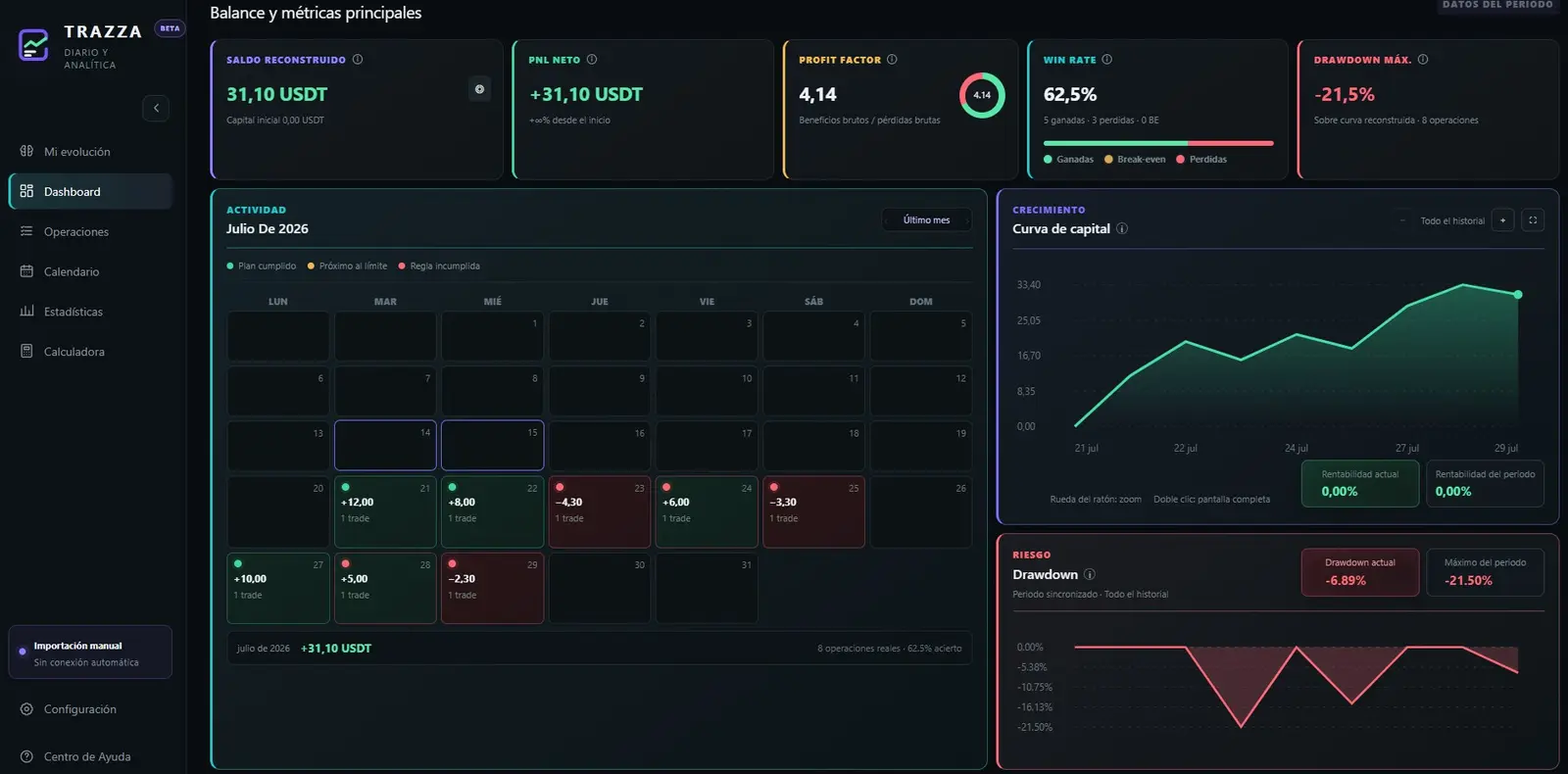
A trading journal is an organised record of your trades. Its value does not come from collecting entries, exits and outcomes, but from reconstructing what you intended to do, what actually happened and which decision deserves to be repeated or corrected.
Journaling is not about writing more. It is about preserving what you will later need to compare.
History, log and journal are not the same
A broker or exchange history shows orders, executions, costs and outcomes. Keep a backtest separate: actual history is essential, but rarely preserves the intention that existed before entry.
A trade log organises those data and adds calculations, tags or screenshots. A journal adds another layer: it connects the outcome with the plan, the decisions taken and the later review. A loss can therefore follow the method while a winning trade can hide an impulsive entry.
TRAZZA brings these layers into one workflow. You can explore the product to see how records, context and analytics connect without turning the journal into an endless form.
- History: answers what happened in the account.
- Trade log: compares organised trades with metrics and tags.
- Journal: explains why you decided that way and which behaviour deserves attention.
What should a trading journal include?
There is no universal template. Start with objective data: date, instrument, direction, entry, exit, size, stop, target and planned risk-reward ratio, fees, funding and net result. Import these when possible to reduce work and manual errors.
Add plan and context: setup, entry condition, invalidation, maximum risk and a screenshot near the decision. “Good opportunity” is not a useful setup; choose names and criteria you can apply consistently.
Keep only meaningful changes during the trade and their reasons. Then record adherence, dominant emotion, observable behaviour, lesson and one action worth testing. The guide to recording emotions in a trading journal develops this approach.
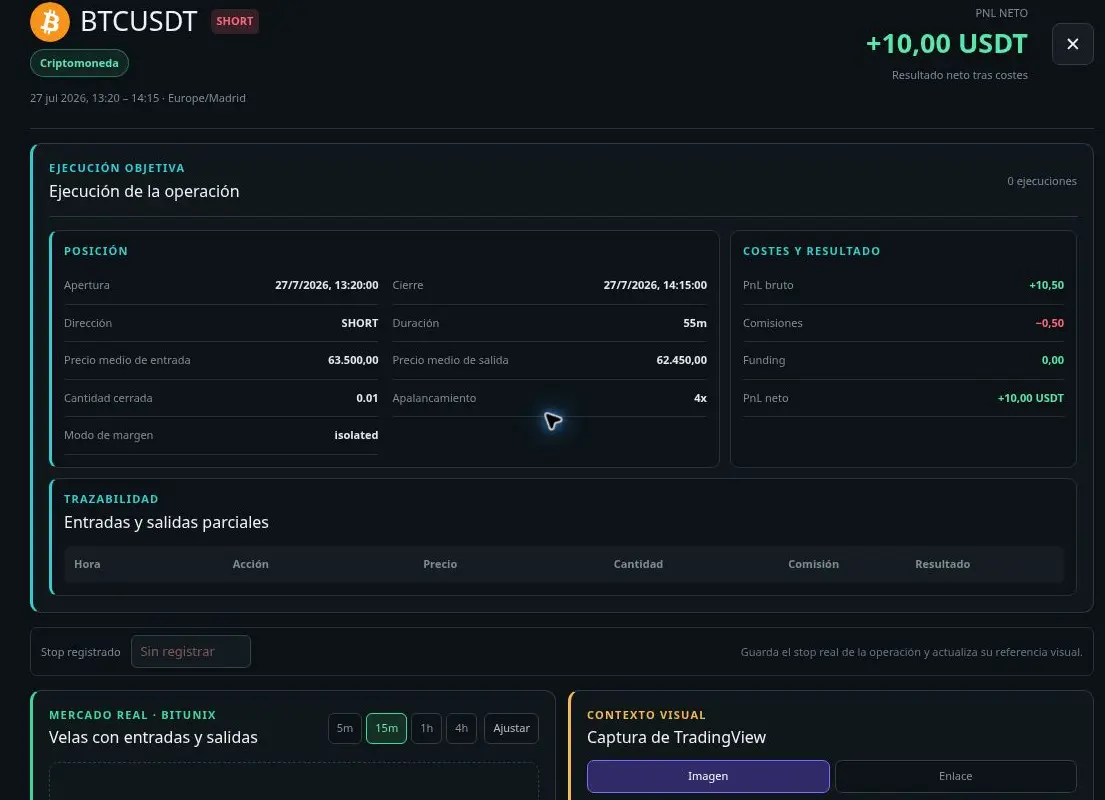
What to record before, during and after
Spreading the work across the decision prevents memory from filling gaps with information that only became available later. Before entry, note the setup, entry condition, invalidation, maximum risk and the scenario that would reject the trade. Your trading plan defines the general rules; the journal shows how they were applied.
During the trade, record changes such as moving a stop or adding risk to detect loss aversion. A short note made at the time is more reliable than a polished explanation written after the outcome is known.
Afterwards, verify the data, assess execution and separate process from outcome. Finish with one sentence: what would you keep and what will you observe next? How TRAZZA works explains this cycle of recording, reviewing and learning.
Example of a documented trade
Consider a simulated BTC/USDT intraday trade based on a confirmed breakout and retest. Planned risk is 0.75% and actual risk becomes 0.78%. Invalidation is a five-minute close below the reclaimed zone, while the pre-trade emotion is urgency 2/5.
Entry and risk follow the plan, but a partial exit at 1R was not planned. Net outcome is +1.35R after costs. The lesson is not “the trade was good”, but “define when a partial exit is allowed”.
Profit does not automatically make execution correct. One trade raises the question; several comparable trades help answer it.
How to review without drowning in metrics
Start with one question instead of every statistic. After each trade, verify the data; at the end of the week, compare a small group and choose one finding; with an adequate sample, analyse patterns by setup, risk, time, instrument or behaviour. A weekly trading review provides a short routine.
Keep outcome, risk, execution and behaviour separate. Then translate the finding into a testable action. “Be more disciplined” is difficult to verify; “for the next ten trades, wait for the confirmation close” can be measured.
The TRAZZA Method follows that cycle: record, observe, act and check. Once your journal is consistent, analysing your trading history helps you move from isolated trades to patterns.
Notebook, spreadsheet or application?
The best format is the one you can maintain without losing essential information. A notebook supports reflection but makes calculations and searches difficult. A spreadsheet is flexible and sufficient at first, although it requires data entry, formulas and screenshot management.
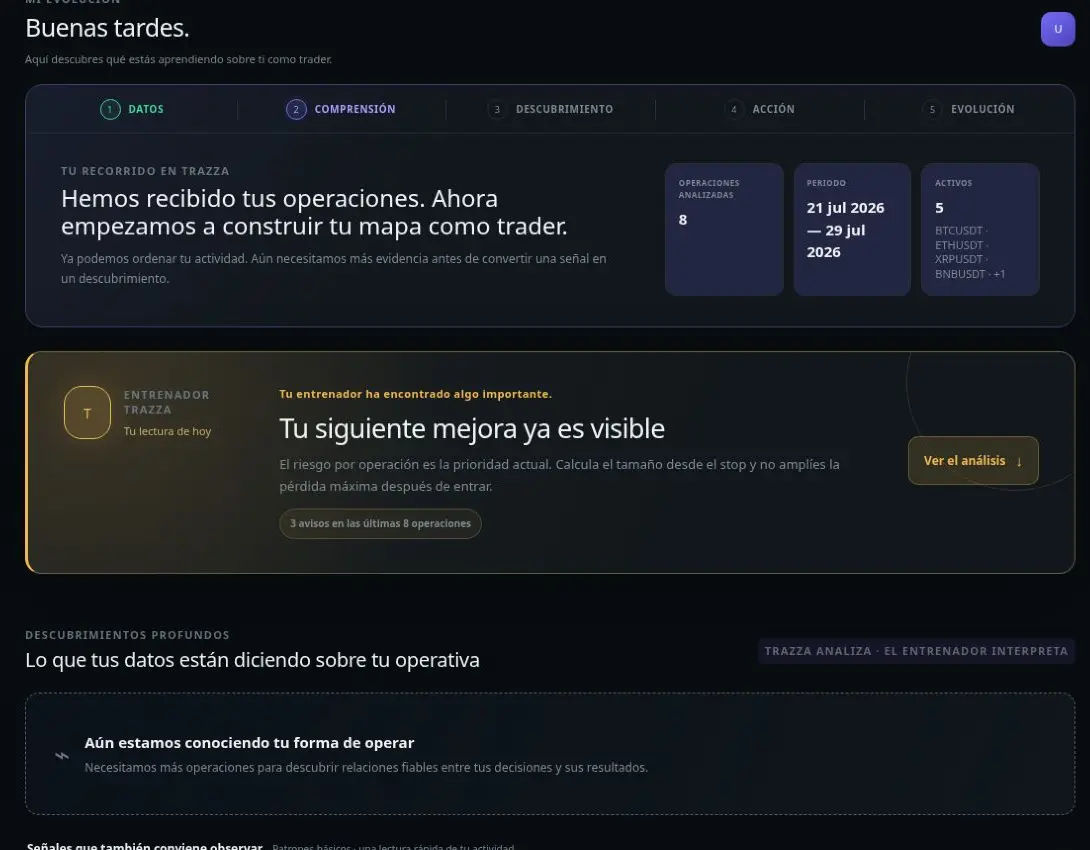
A specialist application can import trades, normalise data and connect metrics with context. It should reduce work, not add fields for decoration. Check supported platforms, cost handling, credential security, export options and whether you can trace a conclusion back to the trades supporting it.
Common mistakes and how to start today
Recording only losses creates a biased sample. Writing a lot but classifying very little makes comparison difficult. Judging only by outcome can reward a dangerous exception. Confusing coincidence with a pattern produces conclusions before enough evidence exists. The guide to trading mistakes for beginners covers behaviours that can appear before, during and after a trade.
Begin with eight fields: instrument, setup, entry, exit, planned risk, adherence, emotion and lesson. For two weeks, test whether the record is sustainable and whether your tags keep the same meaning. Then choose one question, compare similar cases and define one small action.
TRAZZA is designed to import objective data, preserve context and help you inspect repeated behaviour. If you want to learn about the system before public release, you can request access to TRAZZA.
Review checklist
- ✓Record every trade, not only losses or memorable cases.
- ✓Keep risk, costs, setup and adherence alongside the outcome.
- ✓Use stable tags that make comparable cases easy to find.
- ✓Distinguish coincidence from a pattern supported by an adequate sample.
- ✓End each review with one specific action you can verify.
Frequently asked questions
What should a beginner record?+
At minimum: instrument, date, direction, entry, exit, size, risk, costs, setup, adherence and one lesson. Add emotions and screenshots when they provide context.
Is Excel better than an application?+
Excel may be enough at first. An application adds value when you need to import trades, reduce manual errors and analyse groups without maintaining formulas and tags yourself.
Should winning trades be recorded?+
Yes. Excluding them distorts the sample and prevents you from checking whether profit came from sound execution or a favourable exception.
Can a trading journal improve profitability?+
It cannot guarantee results or remove risk. It can help reveal behaviour, apply limits and review decisions more clearly.