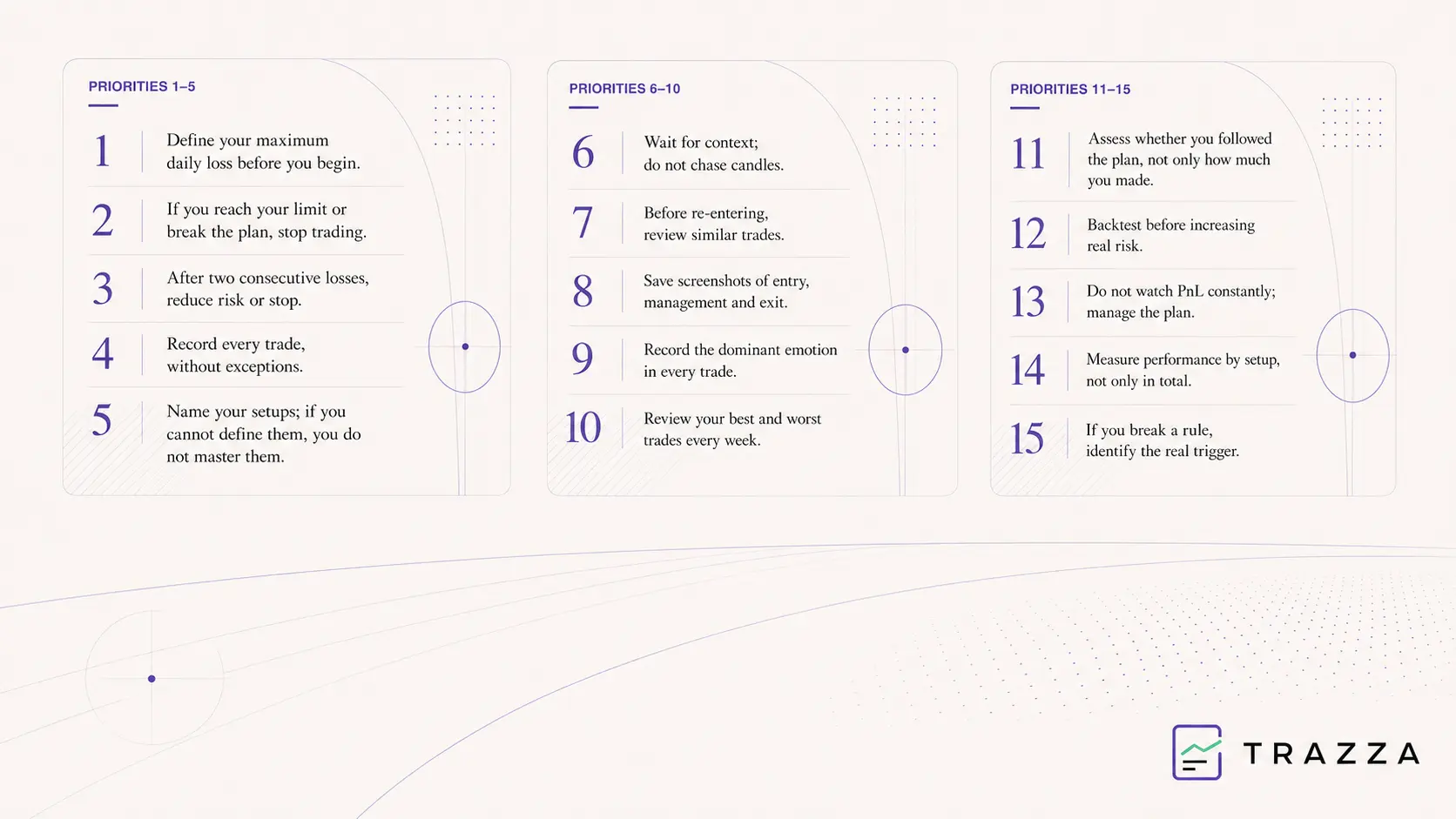
Some days, following a plan feels easy. The market is calm, the entry appears where you expected it and you feel no urge to do anything unusual. Discipline is tested on the other days: when a candle runs away, losses pile up, a trade appears outside your schedule or the result takes over your attention. In those moments, relying on willpower alone is a fragile strategy. Rules let you decide in advance what you will do when thinking calmly becomes more difficult.
Discipline is not about never making mistakes. It is about building a system that helps you detect them, understand them and stop them from becoming a pattern.
Before trading: prepare decisions you can repeat
A disciplined session starts well before you press buy or sell. You need to know what you are looking for, the context in which it makes sense and what would invalidate the trade. The more specific that preparation is, the less room remains for improvisation.
These rules cannot remove uncertainty, but they can limit loss aversion. Their purpose is to stop market uncertainty from turning into personal disorder.
Rule 1. Set your maximum daily loss before you begin
Decide how much you can lose during the session without undermining your stability or ability to think clearly. You can express it as money, a percentage or R multiples. What matters is setting it before you know the first outcome.
A daily limit does not predict how much you will lose. It marks the point at which further trading no longer belongs to your trading plan. Record the intended limit, accumulated loss and whether you respected it.
Rule 5. Name and define your setups
A setup should be more specific than ‘it looked ready to go up’. Describe the observable conditions that justify an entry: context, structure, confirmation, invalidation and management.
Giving each setup a name lets you group comparable trades. If everything is labelled ‘good opportunity’, it becomes almost impossible to discover which ideas work and which merely felt convincing at the time.
Rule 6. Wait for context; do not chase candles
When price moves quickly, it can feel as though the opportunity is disappearing forever. A late entry often worsens the price, widens the distance to invalidation or forces risk that no longer fits.
Define what must happen for the entry to remain valid and the maximum distance you will accept. Missing a planned opportunity hurts for a few minutes; turning it into an improvised trade can consume the whole session.
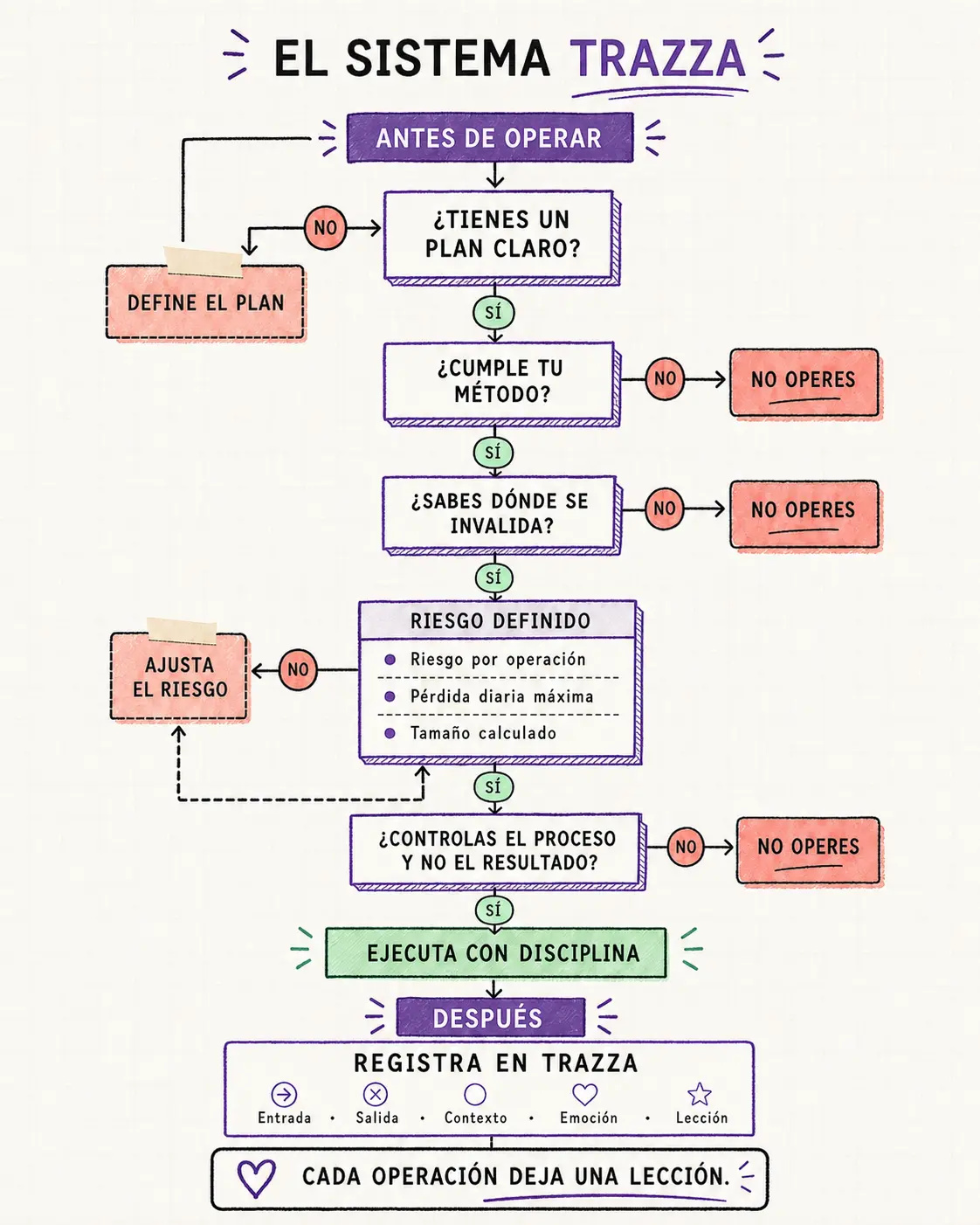
Risk: boundaries that remain in force when your mood changes
Risk cannot depend on the urge to recover a loss or the confidence created by a winning streak. A useful boundary is easy to check and hard to reinterpret when the market applies pressure.
Rule 2. If you reach your limit or break the plan, stop trading
Reaching the daily limit means the session is over, even if the best-looking entry of the week appears next. The rule loses its purpose if it can be negotiated precisely when you need it most.
A serious plan violation is another good reason to pause. This is not punishment; it is a way to recover perspective. Sometimes the main risk is no longer on the chart, but in the state from which you are making decisions.
Rule 3. After several losses, reduce risk or stop
Two consecutive losses can be a useful warning, but they are not a universal law. The right boundary depends on your strategy frequency, win rate, risk per trade and behaviour after a loss.
Define your pause condition with data. It may be a number of losses, an amount in R or a behavioural signal such as rushing entries or increasing size. If the limit changes every day, it is not a limit; it is a suggestion with very little authority.
Rule 12. Backtest before increasing real risk
One good week does not prove that a strategy is ready for more capital. Before increasing size, you need an adequate sample, comparable conditions and results assessed with realistic costs.
Backtesting cannot guarantee the future, but it forces you to test the idea against more cases than the ones you remember. Add demo execution or reduced size to measure something historical data cannot capture well: your own behaviour.
During the trade: manage the plan, not the need to be right
Once a position is open, every price movement can look like new information. It is not always so. Many in-trade decisions come from fear of losing an open gain or hope that a planned loss can still be avoided.
Rule 8. Save screenshots of entry, management and exit
A screenshot preserves context that numbers cannot reconstruct on their own: market structure, entry location and what you saw when you moved a stop or exited early.
You do not need to capture every price change. Three moments are usually enough: entry with the idea visible, any meaningful management decision and the final exit.
Rule 9. Record the dominant emotion in every trade
Writing ‘good’ or ‘bad’ says very little. It is more useful to record the dominant emotion — urgency, fear, overconfidence, frustration — rate its intensity and describe the behaviour it produced.
For example: ‘urgency 4/5; entered before the close’. Across several trades, you can test whether a particular emotion precedes a repeated behaviour. The goal is not to stop feeling, but to recognise when an emotion begins to direct the process.
Rule 13. Do not watch PnL constantly; manage invalidation
PnL translates every small movement into money and can make normal variation feel emotional. If all your attention is on how much you are winning or losing, it becomes easy to forget why the position remains open.
Review the plan conditions instead: invalidation, target, maximum duration, structure and remaining risk. The outcome matters, of course, but it should not be the only piece of information capable of changing your behaviour.
After trading: turn the outcome into information
Closing the position ends market exposure, but not the work. A trade recorded from memory several hours later often loses the exact details that explain the decision.
Rule 4. Record every trade, without exceptions
If you only save interesting, winning or especially painful trades, you will build an incomplete version of your behaviour. Your journal the ordinary trades that appear to have nothing to teach.
Automate objective data where possible and add the human context: setup, entry reason, adherence, emotion, screenshots and lesson. Recording is not about writing a lot; it is about preserving what you will later need to compare.
Rule 11. Assess whether you followed the plan, not only how much you made
A winning trade can be poorly executed, while a loss can follow the method perfectly. If every profit receives praise, you also reinforce impulsive decisions that happened to work this time.
Separate process from outcome. Score preparation, entry, risk and exit. This shows whether the money came from repeatable behaviour or an exception that should not become a habit.
Rule 10. Review your best and worst trades every week
The best trades are not always the biggest winners, and the worst are not necessarily the biggest losses. Choose examples by outcome and execution quality so that you do not inspect only one side of the story.
Look for concrete differences: context, time, setup, stop distance, emotion, management and adherence. A weekly review should end with one small, testable decision, not twenty promises for Monday.
Rule 14. Measure performance by setup, not only in total
The overall result may hide that one setup creates most of the consistency while another consumes time and risk. Good classification lets you compare win rate, average outcome, profit factor, drawdown and adherence by trade type.
Do not abandon a strategy after three examples or declare it successful after two good trades. Use a reasonable sample and distinguish between a weak setup and poor execution by the trader.
When you break a rule: investigate the trigger, not the culprit
Breaking a rule does not invalidate the whole system. The danger lies in leaving it unreviewed or responding with an even stricter rule that you still cannot follow. The useful question is not ‘why am I undisciplined?’, but ‘what happened immediately before, and what decision would have made repetition less likely?’.
Rule 7. Before re-entering, review similar trades
After a stop, re-entry may be part of a valid strategy or a polished way of chasing the market. Before acting, check whether the new entry satisfies the setup and review how comparable situations ended.
Create a short protocol: wait a minimum period, require a fresh confirmation and keep the planned risk. The previous loss does not make the next entry better or worse; what matters is whether a new, complete thesis exists.
Rule 15. If you break a rule, identify the real trigger
Write down what happened before the breach: a loss, a missed opportunity, tiredness, pressure to finish positive, a notification or a conversation. Then describe the exact behaviour and its consequence.
Do not settle for ‘lack of discipline’. That label provides no solution. A specific trigger can produce a practical barrier: hide PnL, block new orders at the limit, move the phone away or require a pause.
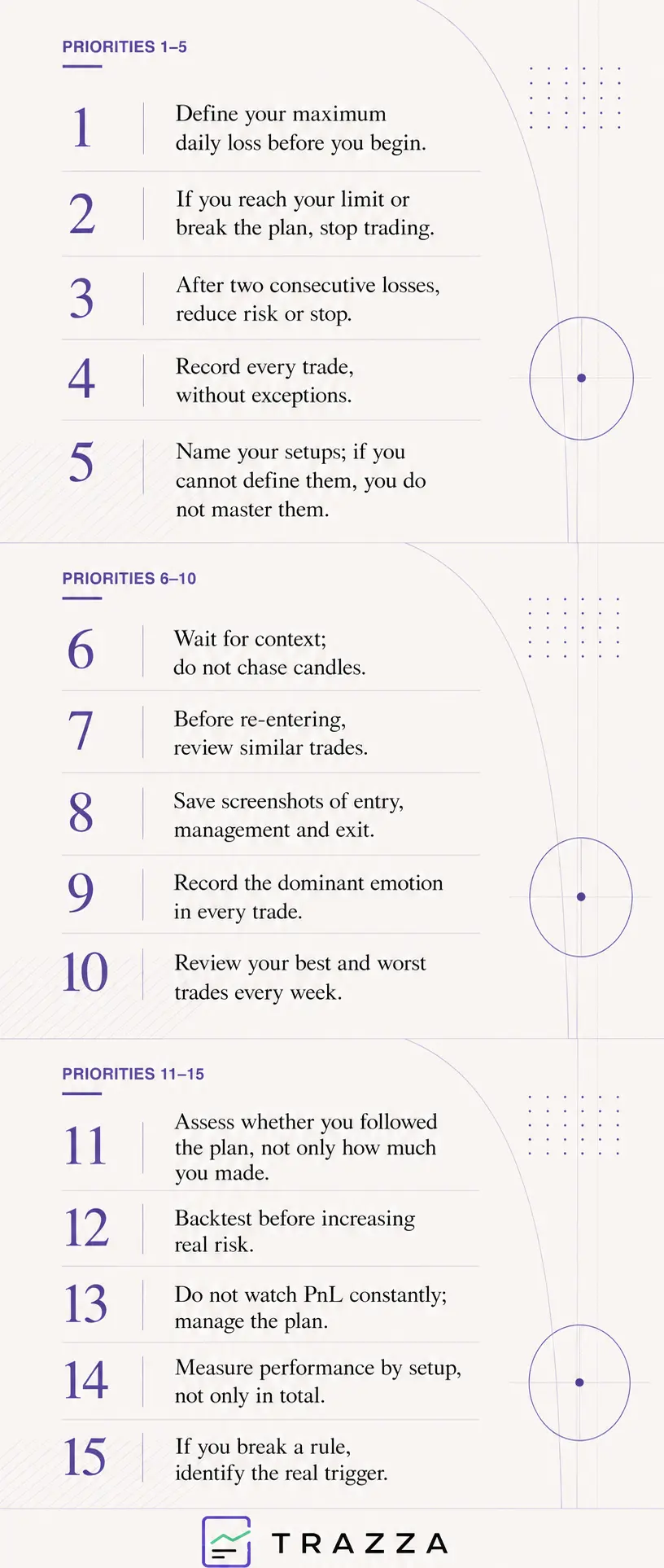
Turn the rules into your own system
You do not need to adopt all fifteen rules with identical numbers. Choose boundaries that fit your strategy, write them in observable terms and review whether they really protect your process.
A useful rule answers four questions: when it activates, what action it requires, how it is recorded and when it will be reviewed. That is how it stops being a well-meant sentence and becomes a measurable part of your method.
How TRAZZA turns rules into evidence
In the TRAZZA Method, a rule becomes useful when it can be observed: what triggers it, which action it requires, whether it was followed and what happens when it is broken. The TRAZZA trading journal brings together the plan, the trade, risk, notes and emotions to compare intention with execution. It does not impose decisions or replace the trader; it preserves evidence so review does not depend on memory alone.
Continue this process with how to create a trading plan, how to record emotions in a trading journal and how to run a weekly trading review.
Review checklist
- ✓I have defined my maximum daily loss and exact stop condition.
- ✓I know which setups I may trade and how they become invalid.
- ✓I set risk before knowing the previous outcome.
- ✓I record every trade with context, emotion and adherence.
- ✓I review performance by setup, not only total PnL.
- ✓When I break a rule, I record the trigger and adjust one barrier.
Frequently asked questions
Do I need to apply all fifteen rules from day one?+
No. Begin with the rules that protect risk and address your most frequent mistakes. Following three observable rules is better than keeping fifteen sentences you never consult.
Should I always stop after two consecutive losses?+
There is no number that works for everyone. Define the pause using your strategy data, accumulated risk and changes in your behaviour after a loss. Two losses can be a warning, not a universal law.
Can a winning trade break the plan?+
Yes. The market may reward an impulsive entry or excessive risk once. Separating outcome from execution prevents you from reinforcing behaviour that could become harmful when repeated.
What should I record when I break a rule?+
Record the trigger, exact behaviour, impact and one practical barrier for next time. Avoid broad explanations such as ‘I lacked discipline’ because they do not show what you can change.
When should I change a trading rule?+
Review it with an adequate sample and away from the session. Change it when the evidence shows that it does not protect the process or cannot be applied as written, not to justify today's decision.