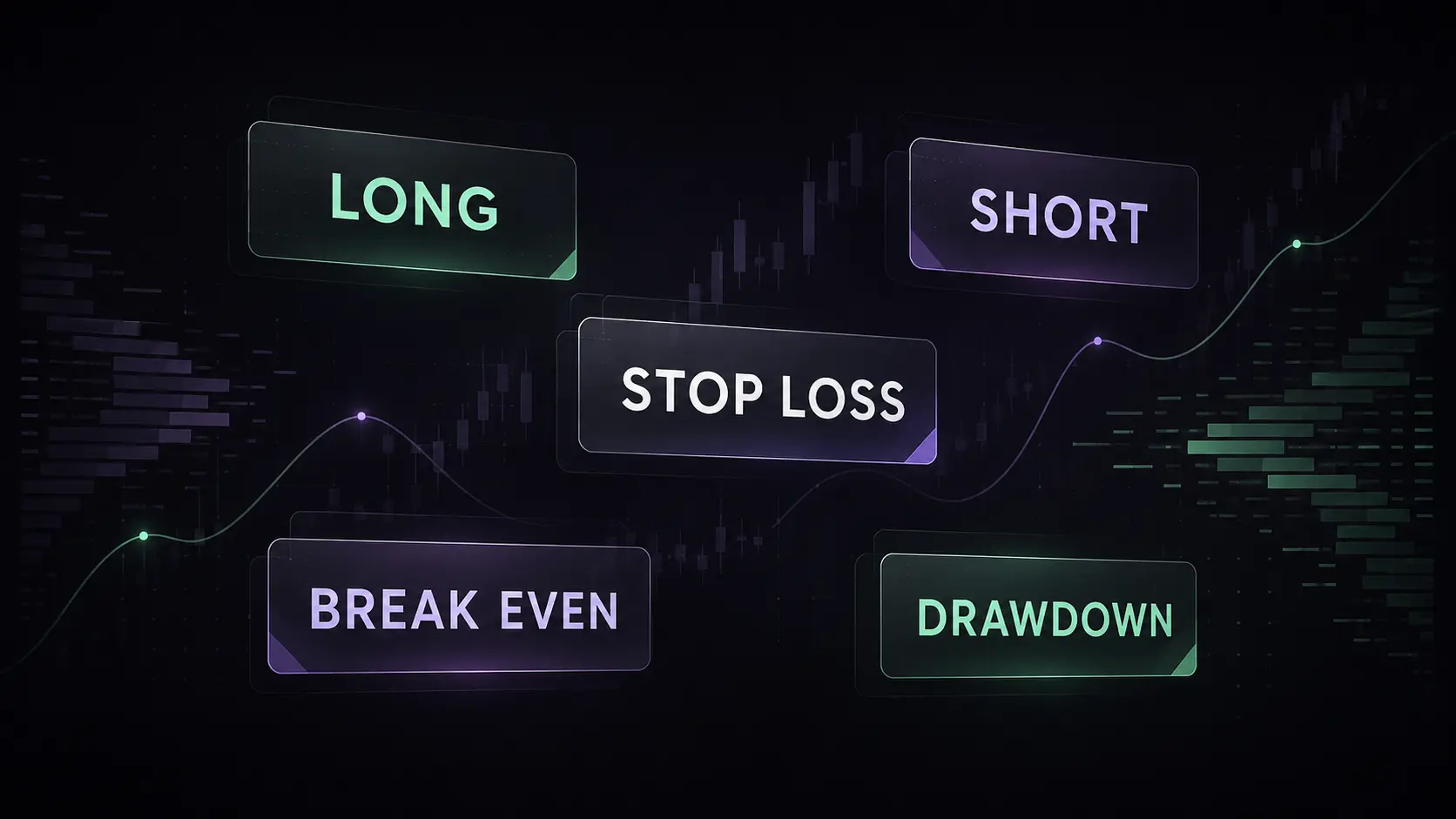
If you are new to trading, the first few days can feel as though you are learning two things at once: how markets work and an entirely new language. Long, short, stop loss, break even, drawdown, funding… You do not need to memorise a whole dictionary before you begin. This guide helps you understand what you are doing, which risks you are taking and which information is worth reviewing afterwards.
Knowing the vocabulary does not automatically make anyone a better trader. It does help you make decisions with more context and record each trade more accurately.
Positions and market direction
Long position
A long position expects the price to rise. You enter at one price intending to close higher. The word describes the direction of the trade, not certainty about what the market will do.
Short position
A short position expects the price to fall. In derivatives markets, it can benefit from a decline; if the price rises instead, the position loses value.
Bull and bear markets
A bull market has a broadly rising trend; a bear market has a broadly falling one. Timeframe matters: an asset can be bullish on a daily chart and bearish over the last two hours.
Entry
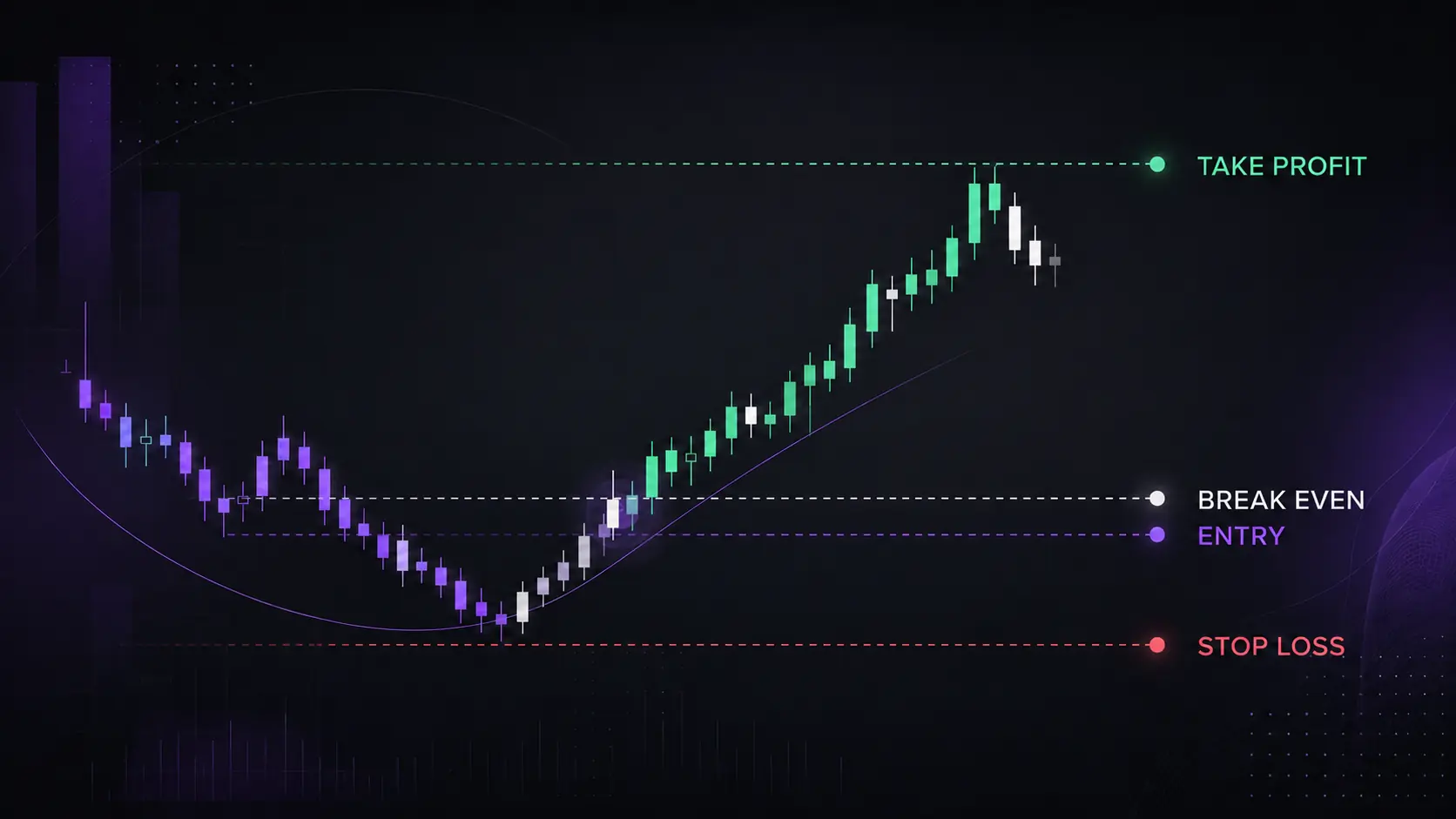
The price, or group of prices, at which a position is opened. Order type, liquidity and volatility can make the actual fill differ from the price you saw.
Exit
The full or partial closing of a position, whether manual or triggered by a take profit, stop loss, liquidation or another programmed condition.
Position size
The amount of capital or number of units exposed in a trade. A promising entry can still carry excessive risk when the position is too large.
Scaling into a position
Building a position through several planned orders rather than entering all at once. It needs predefined levels, a maximum size and a clear reason; it is not unlimited adding to a losing trade.
Partial close
Closing only part of a position and leaving the rest open. Record every partial exit so average exit price and the final result remain accurate.
Prices, orders and execution
Bid and ask
The bid is the best price a buyer currently offers. The ask is the lowest price a seller accepts. A transaction happens when both sides meet.
Spread
The difference between bid and ask. A wide spread can increase entry and exit costs, particularly in illiquid assets or volatile periods.
Market order
An order that seeks immediate execution at the best available price. It prioritises speed, not an exact price, and may fill across several price levels.
Limit order
An order setting the highest price you will pay or the lowest price you will accept. It offers price control but does not guarantee execution.
Stop order
An order activated when price reaches a defined level. A stop-market prioritises getting out; a stop-limit controls price but may remain unfilled.
Fill and partial fill
A fill is an executed order. A partial fill occurs when only part of the requested quantity can be executed under the available conditions.
Slippage
The difference between the expected and actual execution price. It can result from volatility, limited liquidity or execution speed, and it is not always negative.
Liquidity
How easily an asset can be bought or sold without materially moving its price. Liquid markets usually have more orders and tighter spreads.
Volatility
The intensity and frequency of price changes. Higher volatility does not predict direction; it can also widen slippage and accelerate losses.
Maker and taker
A maker order adds liquidity by waiting in the order book. A taker order removes liquidity by matching an existing order. A limit order can still be a taker if it executes immediately.
Risk management
Stop loss
An order or level intended to limit a loss when the market invalidates your idea. In a fast move, slippage means it may not execute at the exact expected price.
Take profit
An order intended to close all or part of a position at a favourable target. The target is not guaranteed to be reached or filled.
Break even
The point where a trade has no meaningful profit or loss. Closing at the entry price may still leave a small net loss after fees, funding and slippage.
Trailing stop
A dynamic stop that follows price as it moves in your favour but does not move backwards during a retracement. A distance that is too tight may be triggered by ordinary market noise.
Risk per trade
The maximum amount you plan to lose if a trade fails. It is not the same as the capital invested: risk depends on position size, stop distance, instrument and leverage.
Risk-reward ratio
A comparison between the amount at risk and the intended reward. A planned 1:2 ratio is not the final outcome and must be read alongside win rate and costs.
R and R-multiples
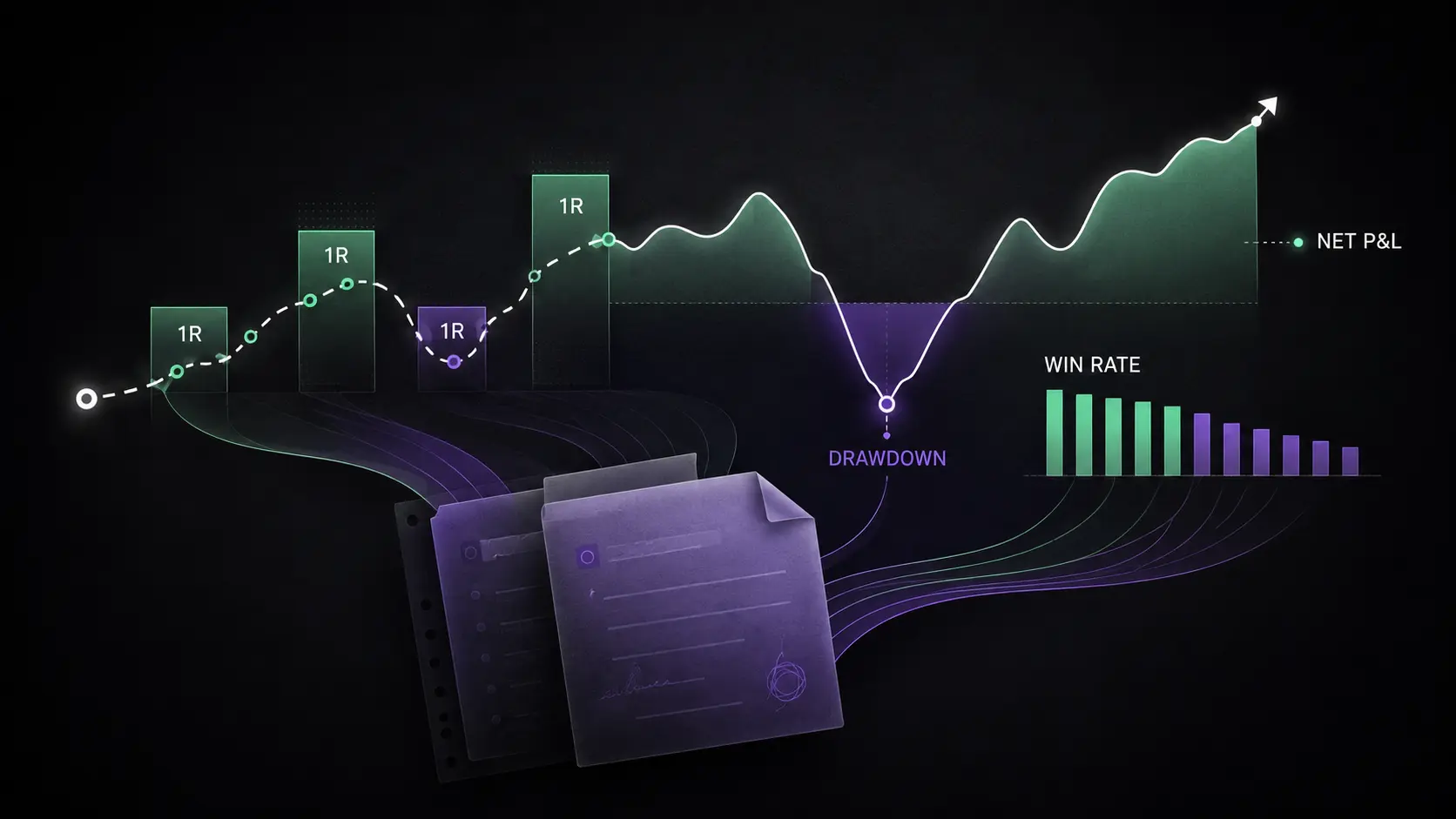
1R is the initial risk on a trade. If you risk 50 euros, losing 50 is −1R, gaining 100 is +2R and gaining 25 is +0.5R. R makes trades of different sizes comparable.
Leverage
Leverage allows a position larger than the margin supplied. It magnifies exposure in both directions, accelerates losses and moves liquidation closer; it does not create a statistical edge.
Margin
Capital held as collateral for a leveraged position. It is not necessarily the maximum possible loss and can change with unrealised P&L, fees and other open positions.
Margin call
A warning that available capital is approaching the minimum required to maintain a position. Some markets liquidate automatically, so relying on receiving or responding to the warning is unsafe.
Liquidation price
The approximate level at which the platform may forcibly close a position because margin no longer covers its requirements. It is not a stop loss and may be calculated from a reference price.
Drawdown
Drawdown is the decline from an equity peak to the following low before a new peak is reached. It describes accumulated deterioration over a period, not a single loss.
Spot, futures and crypto
Spot market
A market where the asset is bought or sold for immediate or near-immediate settlement. Buying bitcoin on spot generally means holding the asset itself.
Futures
Derivative contracts whose value follows an underlying asset. They may allow long and short positions and leverage without requiring ownership of the asset.
Perpetual contract
A futures-style contract with no expiry date, common in crypto. Funding helps keep its price close to the spot market.
Funding rate
A periodic payment between long and short holders in many perpetual contracts. It can reduce net P&L even when the trade direction was correct.
Open interest
The number or value of derivative contracts that remain open. Rising open interest shows that exposure is entering the market, but does not predict whether price will rise or fall.
Isolated margin
Margin assigned to one specific position. It helps separate risk between positions, although it does not remove liquidation risk.
Cross margin
A mode in which positions share available account balance as collateral. It can delay one liquidation but exposes more of the account. Cross does not mean safer; it means shared.
Collateral
The asset used as security for a position. If the collateral itself changes in value, risk can come from both the trade and the asset backing it.
Mark price
A calculated reference price used by many platforms for unrealised P&L and liquidations, reducing the effect of brief movements in the last traded price.
Realised and unrealised P&L
Unrealised P&L estimates the result of an open position. Realised P&L belongs to the closed portion, but it may still differ from final net profit after fees and funding.
Metrics and the trading journal
This is where a journal becomes more than a list of entries and exits: the numbers begin to describe the quality and consistency of your decisions.
Win rate
The percentage of trades that ended positively. Six wins out of ten is a 60% win rate, but the strategy can still lose money if average losses are much larger than average wins.
Average win and average loss
The average result of winning and losing trades. Comparing them shows how much wins contribute, how much losses damage the account and whether exits are asymmetric.
Profit factor
Gross profit divided by gross loss. A value above 1 means gains exceeded losses in that sample, but a small sample or one exceptional trade can distort it.
Expectancy
The estimated average result per trade, combining win and loss frequency with their average sizes. Positive historical expectancy is useful evidence, not a promise about the future.
Equity curve
A chart of account value or cumulative result over time. Its shape reveals stability, streaks, recoveries, deep declines and dependence on a few trades.
Winning and losing streak
A consecutive sequence of positive or negative trades. Even a profitable method can have several losses in a row, while a winning streak does not validate every recent decision.
MAE — Maximum Adverse Excursion
How far a trade moved against you while it was open. Across a meaningful sample, MAE helps examine entry quality and stop placement.
MFE — Maximum Favourable Excursion
How far a trade moved in your favour before closing. Repeated differences between MFE and final result can reveal how consistently exit rules are being applied.
Gross and net result
Gross P&L reflects the market move before certain costs. Net P&L subtracts fees, funding and other charges and is the amount that actually affects the account.
Fees
Charges applied by the platform to execution or other services. Small fees matter, especially in high-frequency approaches where they can materially alter the monthly result.
Consistency
Consistency does not mean winning every day. It means applying comparable risk and rules over time so that decisions can be reviewed meaningfully.
Plan adherence
Whether the entry, risk, size, invalidation, exit and setup conditions followed the plan. A well-executed loss can be useful evidence; a profit outside the plan can reinforce a dangerous habit.
Common trader expressions
Setup
The defined conditions required before considering a trade, such as structure, level, volume, session, context and risk rules.
Breakout
A move through a relevant level, zone or structure. Not every breakout continues; some fail or return to test the level.
Retest
Price returning to a recently broken area to test it again. It is an observation about price behaviour, not a guarantee of continuation.
Fakeout
A move through a level that quickly returns to the previous range. It can trigger entries or stops without necessarily implying manipulation.
FOMO
Fear of missing out. It appears when a fast move creates pressure to enter late, increase size or ignore the original rules.
Revenge trading
Trading with the emotional aim of quickly recovering a loss, often through larger positions, repeated entries or weaker setups. The next trade owes the previous one nothing.
Overtrading
Excessive trading: too many entries, disproportionate exposure or decisions without a genuine setup. The threshold depends on the strategy and its plan.
Bias
An inclination that shapes how information is interpreted. It may be a market view or a mental pattern, such as seeking only evidence that confirms an existing idea.
Confluence
Several independent reasons supporting the same idea. Multiple indicators measuring essentially the same thing do not necessarily create stronger confluence.
Edge
A statistical or execution advantage that offers favourable expectancy over a sufficient sample. It does not prevent losses and cannot be demonstrated with only a handful of trades.
Trading plan
The rules defining what you trade, when you may enter, how much you risk, how you manage the position and when you must stay out.
Pip, tick, point and basis point are not the same
These words all describe movements or units, but they belong to different contexts.
Pip
A conventional unit used mainly in foreign exchange. For many currency pairs it is the fourth decimal place, although exceptions exist.
Tick
The smallest permitted price movement for an instrument. Its size and monetary value depend on the market and contract.
Point
Usually one full unit of a quoted price. In an index, a move from 5,000 to 5,001 is one point, which may contain several ticks.
Basis point (bp)
One hundredth of a percentage point: 100 basis points equal one percentage point. Spoken English may pronounce bp like “bip”, which is different from a forex pip.
Learn the language without memorising everything
You do not need to study these words for an exam. Vocabulary becomes familiar when you connect it with your own decisions.
After each trade, identify direction, order type, actual execution, initial risk, R result, costs, setup and plan adherence. Add one brief note about your emotional state.
Over time, unfamiliar labels become precise descriptions of your behaviour. That is the value of a trading journal: it reconstructs what happened between the original idea and the final result.
Understand the words to understand your decisions
Trading is full of English terms, abbreviations and metrics. You do not need to sound like a professional; you need to understand any figure that affects risk, execution or the evaluation of your results.
Break even can hide costs. A high win rate can coexist with losses. A winning trade can be outside the plan, and a well-managed loss can be correctly executed.
Once you can distinguish those situations, vocabulary stops being jargon and becomes a tool for asking better questions. Every trade leaves a result. If you know how to observe it, it also leaves a lesson.
Review checklist
- ✓Identify direction: long or short.
- ✓Record order type and actual execution price.
- ✓Record initial risk and the result in R.
- ✓Separate gross result from net result.
- ✓Check fees, funding and slippage.
- ✓Describe the setup and plan adherence.
- ✓Add one brief emotional observation.
Frequently asked questions
Do I need to know all these terms before I start?+
No. Begin with the product you use, order types and risk. The remaining concepts will make more sense as you record and review trades.
Does break even mean I lost nothing?+
Not always. Even when you close at the entry price, fees, funding or slippage can leave a slightly negative net result.
Does a high win rate make a strategy profitable?+
Not by itself. You also need average win, average loss, costs, drawdown and a sufficiently large sample.
What is the difference between futures and spot?+
Spot trading buys or sells the asset itself. Futures trade a derivative contract linked to its price, usually with specific margin rules and optional leverage.
Do pip and tick mean the same thing?+
No. A pip is a conventional forex unit. A tick is the smallest price increment permitted for an instrument.
Which terms should I record in a trading journal?+
At minimum: direction, entry, exit, size, risk, stop loss, gross and net result, fees, setup and plan adherence. MAE, MFE and R can add useful context.